






Quick Answer
At OLLITAL, we do not treat dry ice loss as a storage-box problem alone. The biggest improvement usually comes from shortening the total time between dry ice production and use, protecting pellet quality during packaging and transfer, keeping storage containers closed as much as practical, and matching production waves to the real blasting or dispatch schedule. The objective is not to eliminate sublimation completely - that is not possible - but to reduce unnecessary holding, repeated handling and avoidable pellet damage so that a larger share of the dry ice you produce is still usable when the operator needs it.
If you are planning a complete system, start with the current OLLITAL dry ice production machine range, then review how packaging, storage and the final cleaning process fit the same operating schedule.
We Look at Loss as a Process, Not a Single Number
Customers often ask us, "How much dry ice will I lose in storage?" We understand why that question matters, but in real operation we first ask something broader: how long does the dry ice wait, how many times is it moved, what happens during packaging, which container is used, and when does the final application actually begin? Those questions usually tell us more than one isolated loss percentage.
Dry ice continuously changes from solid CO2 to gas. Insulation can slow heat gain, but it cannot stop the physical process. That means the most practical loss-reduction strategy is to control time and handling. If dry ice is produced too early, packaged and unpackaged several times, moved through warm areas, or left in an oversized buffer that is opened repeatedly, the operation is creating avoidable exposure before the product ever reaches the job.
Our approach is therefore simple: protect dry ice pellets when they are fresh, keep the workflow short, and make every intermediate step serve a clear purpose. A production plant, distribution center and blasting workshop may use different equipment, but the same principle applies to all three.
1. Start with the Production Schedule
The best place to reduce dry ice loss is often before the product enters storage. At OLLITAL, we recommend working backward from the next real use or dispatch window. If a blasting crew starts at 10:00, the production schedule should be built around that demand instead of simply filling the storage box whenever the machine is available.
This matters because every extra hour between production and use becomes additional holding time. A larger dry ice production machine can be valuable when it helps you produce the required amount closer to use. A smaller machine can also work well when demand is predictable and the available production window is long enough. The right capacity is the one that supports the operating clock, not simply the largest number on a specification sheet.
We also recommend avoiding large batches that are produced only because the machine is already running. If the extra dry ice has no assigned customer, route, production shift or cleaning task, it becomes speculative buffer stock. In many facilities, better scheduling reduces loss more effectively than adding more storage capacity.
2. Packaging Should Protect the Product, Not Add More Handling
Dry ice packaging has two jobs: make the product easier to handle and help keep the downstream workflow organized. It should not create unnecessary impact, waiting or repeated transfers. When pellets move through a packaging line, every drop, squeeze, vibration and transfer point can create smaller pieces or fines if the process is too aggressive.
For this reason, we normally look at the complete packaging path rather than the wrapper alone. Product feed, weighing or metering, bag forming, sealing, finished-pack discharge and the move into insulated storage should work as one connected sequence. If finished bags sit on a conveyor for a long time before they are collected, the packaging machine may be performing correctly while the overall process is still creating avoidable exposure.
Our OLT-360 horizontal packaging platform can be integrated with weighing and conveying equipment, which allows the packaging step to become part of a controlled line rather than a separate manual task. The correct bag size, film and operating speed should still be selected around the real dry ice form and target pack weight.
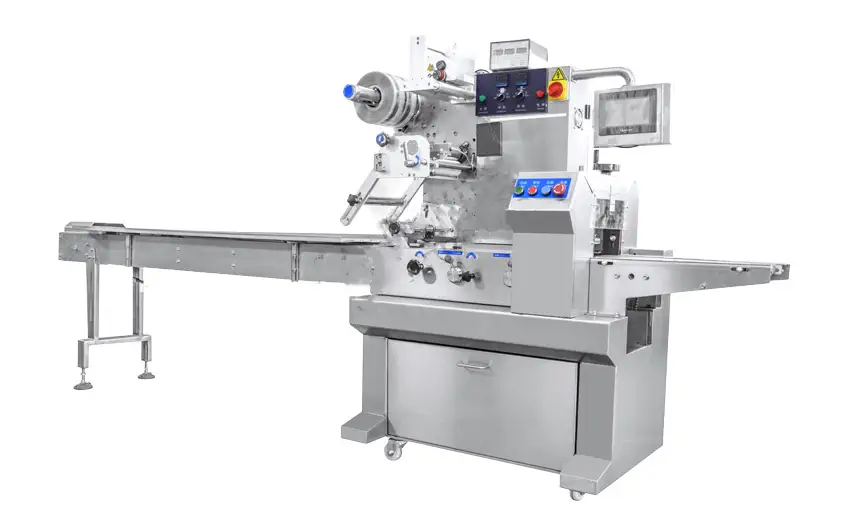
Real dry ice packaging equipment reference supplied for this project. We use packaging as part of the handling strategy, not as an isolated step.
For line planning, see the OLLITAL horizontal automatic packaging machine and confirm the final film, bag and integration requirements for your project.
3. Storage Time Matters More Than "Storage Capacity"
A dry ice storage box is a working buffer. We do not recommend treating it like a conventional warehouse where more inventory is automatically better. The useful question is not only how many kilograms fit inside the container. It is how long the dry ice will remain there before it is used, and how often the lid must be opened during that period.
Insulated containers reduce heat transfer, but dry ice sublimation continues. Frequent opening, warm ambient conditions and unnecessary transfers all add heat to the system. A good storage plan therefore combines the right container size with disciplined use: load it close to the required time, keep the lid closed when access is not needed, and avoid using one large box as a constantly opened source for many small workstations if a distributed buffer would work better.
At OLLITAL, we offer different storage formats because operating patterns are different. A smaller container can make sense near a point of use, while a larger container can work better as a central buffer for a higher-volume production or dispatch area. The correct answer depends on movement, access and turnover, not only nominal capacity.

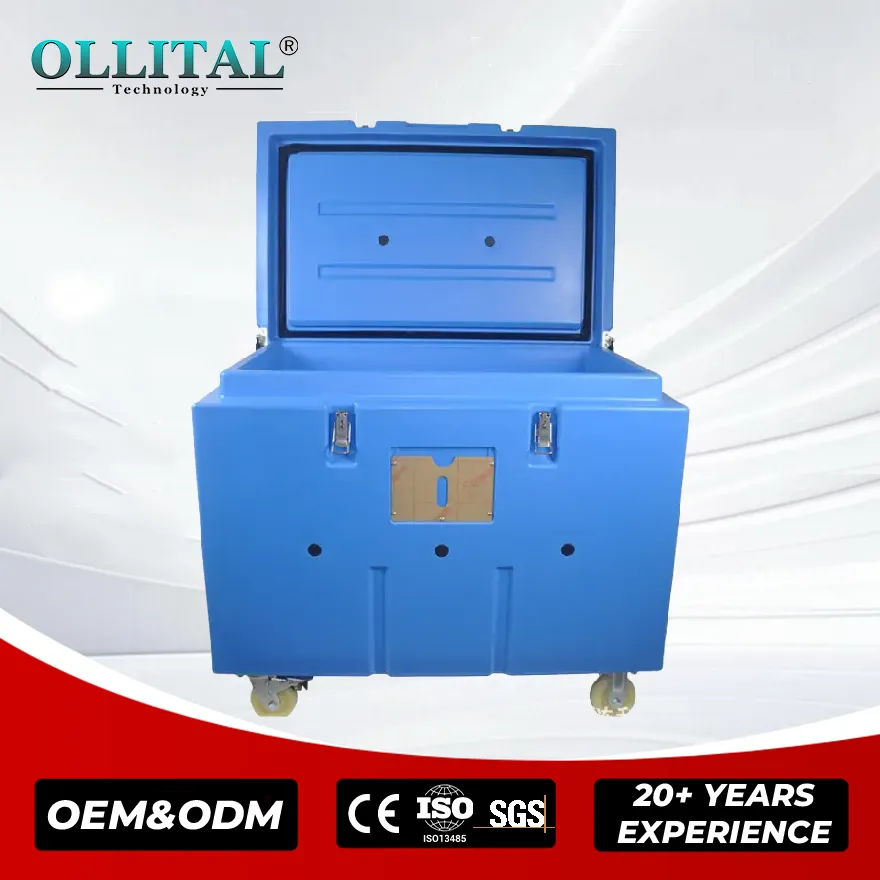
Real large-capacity dry ice storage box reference. Container size should match turnover and handling frequency, not only the maximum quantity you can store.
For smaller distributed buffers, review the 50 kg dry ice storage box. For larger centralized storage, see the 270 kg large-capacity storage box.
4. Reduce Transfers Before You Buy More Storage
One of the easiest losses to overlook is the number of times dry ice changes containers. A typical inefficient workflow may look like this: production bin to temporary tote, tote to packaging area, package to staging box, staging box to transport box, transport box to a workshop container, and finally into the dry ice blasting machine. Every extra handoff takes time and creates an opportunity for breakage, warming and spillage.
We recommend drawing the real movement path on paper. Count each transfer. Then ask whether every transfer adds value. If the only reason a transfer exists is because two work areas are poorly positioned, a layout change may save more dry ice over time than a larger insulated box.
Transfer distance matters as well. If dry ice must cross a warm loading area, wait for a forklift, or sit beside a dock before loading, the operational loss is not caused by the storage box. It is caused by the sequence. Shorter routes, prepared containers and clear dispatch timing usually improve the result without changing the production machine.
5. Separate "Necessary Buffer" from "Comfort Buffer"
A buffer is useful when it protects continuity. For example, a blasting operation may need enough usable dry ice to finish a cleaning job even if production stops briefly. A distribution route may need product ready before a fixed truck departure. Those are necessary buffers because they protect a real operating requirement.
A comfort buffer is different. It is inventory held simply because the team feels safer when the box looks full. With dry ice, that habit has a cost because the product is continuously sublimating while it waits. We therefore recommend defining the buffer by time and purpose: "enough for the next four-hour cleaning window" is more useful than "keep the 270 kg box full."
This distinction is especially important when demand changes by day. A buffer that makes sense during a peak period may be excessive during a light production day. The best operating plan is allowed to change with the workload.
6. Blasting Performance Is Part of the Loss Calculation
Dry ice loss does not end when the pellets reach the dry ice blasting machine. Poor pellet condition can increase consumption at the point of use. If pellets contain too many fines, are badly broken, or have changed significantly during long storage, feeding can become less stable and the operator may respond by increasing flow or extending cleaning time.
At OLLITAL, when a customer tells us that dry ice consumption has increased, we do not immediately assume the cleaning machine is the cause. We first look at pellet condition, time since production, storage history, compressor conditions, nozzle choice, cleaning distance and the actual contamination. The complete system determines how much dry ice is needed to finish the job.
Fresh, consistent pellets make process control easier. They do not guarantee the lowest possible consumption in every application, but they remove one major source of variation. That is why production timing and storage discipline are directly connected to blasting economics.
For compact cleaning applications, the current OLLITAL P60 dry ice blasting machine is one example of how the final cleaning stage should be matched to the available dry ice and compressed-air conditions.
7. Build a Simple Dry Ice Loss Budget
You do not need a complex software system to understand where usable dry ice is disappearing. We recommend starting with a simple loss budget. Record how much dry ice leaves production, how much reaches packaging, how much is loaded into storage, how much reaches the point of use, and how much remains after the scheduled job or dispatch. The purpose is not to create a perfect laboratory balance. It is to identify which stage deserves attention first.
| Stage | What to record | What a problem may look like |
|---|---|---|
| Production | Quantity and production time | Produced too early for the real use window |
| Packaging | Packed quantity and time to storage | Waiting, breakage or repeated manual transfer |
| Storage | Load time, openings and remaining quantity | Long holding time or frequent lid opening |
| Transfer | Handoffs and transfer duration | Warm waiting areas or too many container changes |
| Blasting / use | Dry ice loaded versus job completed | Consumption rises although the task is unchanged |
After one or two weeks of normal operation, the pattern usually becomes clearer. If most of the difference appears between storage and use, focus on holding time and access. If most of it appears before storage, review packaging and transfer. If the physical quantity is still available but cleaning consumption rises, investigate pellet condition and blasting settings.
8. What We Would Change First
When we review a dry ice workflow, we prefer to start with low-cost operational changes before recommending additional equipment. In many facilities, the first improvements are scheduling and handling changes rather than hardware changes.
Produce closer to the real use or dispatch window instead of filling storage too early.
Assign finished dry ice to a job, route or production shift as soon as practical.
Move packaged dry ice into insulated storage quickly instead of leaving it on an open conveyor or workbench.
Reduce the number of containers used between production and the final application.
Keep storage lids closed and organize access so operators do not repeatedly open a large central box for small withdrawals.
Match storage capacity to turnover: smaller distributed buffers for local use, larger central buffers for bulk demand.
Check pellet condition before increasing blasting flow when cleaning performance changes.
Record real quantities and times so decisions are based on the workflow rather than estimates.
9. When Equipment Changes Do Make Sense
Operational discipline has limits. If demand is growing, production is consistently too early because the existing machine cannot make the required quantity inside the available window, or packaging creates a permanent queue, equipment changes can be justified.
A higher-capacity dry ice production machine may shorten the production window. A more integrated packaging line may reduce manual transfers. A larger or additional dry ice storage box may separate route staging from point-of-use supply. The important point is to solve the measured constraint instead of adding equipment to every stage at once.
At OLLITAL, we prefer to understand the complete process before recommending a configuration. If you tell us your daily demand, peak demand, production hours, pack size, storage time, transfer path and final application, we can discuss the equipment around the workflow rather than treating each machine as a separate purchase.
10. A Practical Production-to-Use Routine
For many industrial users, a simple routine is more effective than a complicated control system. The following sequence is a useful starting point:
Confirm the next real dry ice demand window and required quantity.
Run production close enough to that window to avoid unnecessary holding.
Package only the formats that are needed for the scheduled job or dispatch.
Move finished product directly into the assigned insulated storage box.
Keep containers closed and avoid mixing new and old stock without a clear first-in, first-out plan.
Move the correct container directly to the point of use or loading area when the job is ready.
Inspect pellet condition before loading the blasting machine.
Record any unusual loss or consumption and trace it back to the previous stage.
This routine is intentionally straightforward. The goal is consistency. When each team follows the same sequence, it becomes much easier to identify why a particular shift, route or cleaning job used more dry ice than expected.
FAQ
Q: Can dry ice sublimation be stopped completely?
A: No. Dry ice continuously changes from solid CO2 to gas. Insulation and good handling can slow heat gain, but the practical goal is to reduce unnecessary holding time and exposure rather than promise zero loss.
Q: Is a larger storage box always better?
A: No. A larger box is useful when you genuinely need a central buffer or bulk staging. If operators repeatedly open it for small withdrawals, several smaller point-of-use boxes may fit the workflow better.
Q: Should we produce all dry ice at the beginning of the day?
A: Only if the operating schedule requires it. We usually recommend matching production waves to real use or dispatch windows so the product does not wait longer than necessary.
Q: Can packaging increase dry ice loss?
A: Yes, if the process adds long waiting time, repeated drops, friction or manual transfers. A well-organized packaging line should shorten the path from production to insulated storage.
Q: Why does blasting consumption sometimes increase even when the job is the same?
A: We would first check pellet condition, storage time, compressor conditions, nozzle selection and machine settings. Dry ice quality is one part of the total cleaning system.
Q: How do we know whether the problem is storage or handling?
A: Measure the quantity and time at each stage. If the largest difference appears during storage, focus on holding time and access. If the difference appears during transfer, reduce handoffs and exposure.
Q: What information should we send OLLITAL for a loss-reduction review?
A: Send your daily and peak dry ice demand, production capacity, pack sizes, storage method, typical holding time, transfer route, cleaning machine, compressor conditions and the final use schedule.
Q: Do we need new equipment to reduce dry ice loss?
A: Not always. We recommend starting with scheduling, handling and access improvements. Equipment changes make sense when the measured bottleneck cannot be solved by workflow changes alone.
Conclusion
Reducing dry ice loss is not about finding one perfect container or one perfect machine. It is about controlling the time and movement between production and use. At OLLITAL, we recommend looking at the full chain: produce at the right time, package with minimal unnecessary handling, store according to turnover, shorten transfer routes, and use pellets while their condition is still suitable for the application.
When those stages are aligned, you do more than reduce sublimation loss. You also make packaging more predictable, simplify storage, stabilize dry ice blasting performance and create a clearer basis for future equipment decisions.
Want to reduce dry ice loss in your own production-to-use workflow?
Send us your production volume, packaging method, storage arrangement, holding time and final application. We can help you review where the workflow is creating unnecessary waiting or handling and discuss a more practical equipment configuration.