





Quick answer: A dry ice production machine converts liquid CO₂ into solid dry ice pellets or blocks so an industrial cleaning operation can control when and how much dry ice is available. For facilities that use dry ice regularly, on-site production can reduce dependence on delivered dry ice, shorten storage time, and make it easier to match pellet output to actual blasting schedules. The business case, however, depends on dry ice consumption, liquid CO₂ availability, storage losses, labor, operating hours, and the local cost of purchased dry ice. |
Dry ice blasting is often discussed as a cleaning technology, but the cleaning machine is only one part of the system. Every blasting shift depends on a reliable supply of usable dry ice. If pellets are delivered too early, stored for too long, or produced in a quantity that does not match the cleaning schedule, sublimation loss and handling time can become part of the operating cost.
That is why many industrial users look beyond the blaster itself and consider whether a dry ice production machine should become part of the cleaning infrastructure. The objective is not simply to “make dry ice.” It is to build a supply system that connects liquid CO₂ storage, dry ice production, short-term storage, and blasting demand in a practical way.
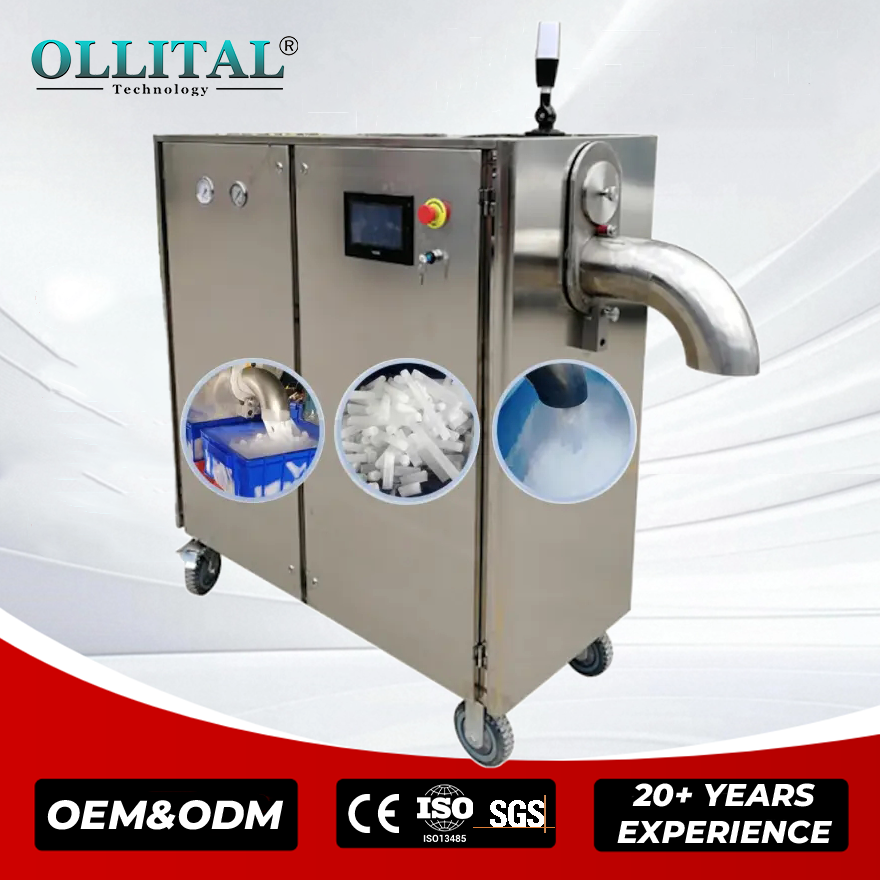
OLLITAL dry ice production equipment for converting liquid CO₂ into dry ice pellets. Click the image to view the 250KG/H model.
Why Dry Ice Supply Matters in Industrial Cleaning
Dry ice does not behave like a conventional abrasive or liquid cleaning chemical. Solid CO₂ continuously sublimates into gas, so the quantity available for cleaning gradually decreases after production. The rate depends on pellet size, container insulation, ambient conditions, handling frequency and storage duration. For a cleaning operation, this means procurement and production timing matter almost as much as the blasting machine itself.
On-site production can be useful when dry ice is consumed frequently enough to justify the equipment and liquid CO₂ infrastructure. A facility may be able to produce closer to the cleaning schedule, keep a smaller buffer inventory, and reduce the uncertainty created by external delivery windows. This does not automatically make in-house production cheaper in every location. A proper comparison should include liquid CO₂ price, conversion efficiency, equipment utilization, labor, electricity, maintenance, storage loss, purchased dry ice pricing and transportation.
How a Dry Ice Production Machine Converts Liquid CO₂ into Pellets
The production process begins with liquid carbon dioxide (LCO₂), not CO₂ gas at normal atmospheric conditions. The liquid is supplied from an appropriate pressure-rated storage system and introduced into the dry ice production equipment. When pressure is reduced inside the production process, part of the CO₂ flashes into gas while the remaining fraction forms cold dry ice snow. That snow is then compressed through a die to form denser pellets.
| 1 | Liquid CO₂ Supply — Liquid CO₂ is stored and delivered under controlled pressure. |
| 2 | Expansion — Pressure reduction causes part of the liquid CO₂ to flash into gas. |
| 3 | Dry Ice Snow — The remaining cold fraction forms solid CO₂ snow. |
| 4 | Compression — The snow is compressed through the selected pellet die. |
| 5 | Collection — Finished pellets are collected for immediate use or short-term storage. |
This phase change should not be described as sublimation. Sublimation is the transition from solid dry ice directly to CO₂ gas. During production, liquid CO₂ undergoes pressure reduction and partial flashing, creating dry ice snow that is mechanically compressed into the required form.
Rated Production Capacity Is Not the Same as Usable Dry Ice Supply
A machine rated at a certain number of kilograms per hour does not mean every kilogram produced will still be available when the operator starts blasting. The useful amount depends on production timing, transfer distance, waiting time, storage conditions and sublimation. Capacity planning therefore needs to work backward from the cleaning operation instead of simply choosing the largest machine.
A practical planning sequence is:
Expected blasting consumption → number of blasting machines → simultaneous operating hours → required buffer stock → estimated handling/storage loss → required production capacity.
OLLITAL currently lists dry ice production equipment across multiple output levels, including 50, 100, 150, 250, 500 and 1000 kg/h models. The right size depends on the operating profile rather than on industry name alone. A plant using one blaster intermittently has a different requirement from a service center running several cleaning jobs per shift or a centralized facility supplying multiple users.
How Much Production Capacity Does an Industrial Cleaning Operation Need?
| Planning Level | Typical Role | Questions to Confirm Before Selection |
|---|---|---|
| 50–100 kg/h | Small on-site supply or intermittent cleaning demand | How many blasting hours occur per day? Is dry ice needed continuously or only in scheduled maintenance windows? |
| 150–250 kg/h | Regular industrial maintenance, multiple jobs or a larger buffer requirement | Will more than one blaster operate? How long can finished pellets remain in storage before use? |
| 500–1000 kg/h | High-volume or centralized production | Is the system supplying multiple lines, multiple users or additional downstream applications beyond blasting? |
| Planning note: These ranges are decision examples, not universal sizing rules. Final selection should be based on measured or estimated hourly dry ice consumption, cleaning schedule, storage strategy, liquid CO₂ availability and future expansion. |
Why Liquid-to-Solid CO₂ Conversion Matters
Production capacity is only part of the operating-cost picture. A dry ice machine receives liquid CO₂, but pressure reduction inevitably creates both solid dry ice and gaseous CO₂. The relationship between liquid input and solid output affects CO₂ consumption, operating cost and the size of the upstream storage system.
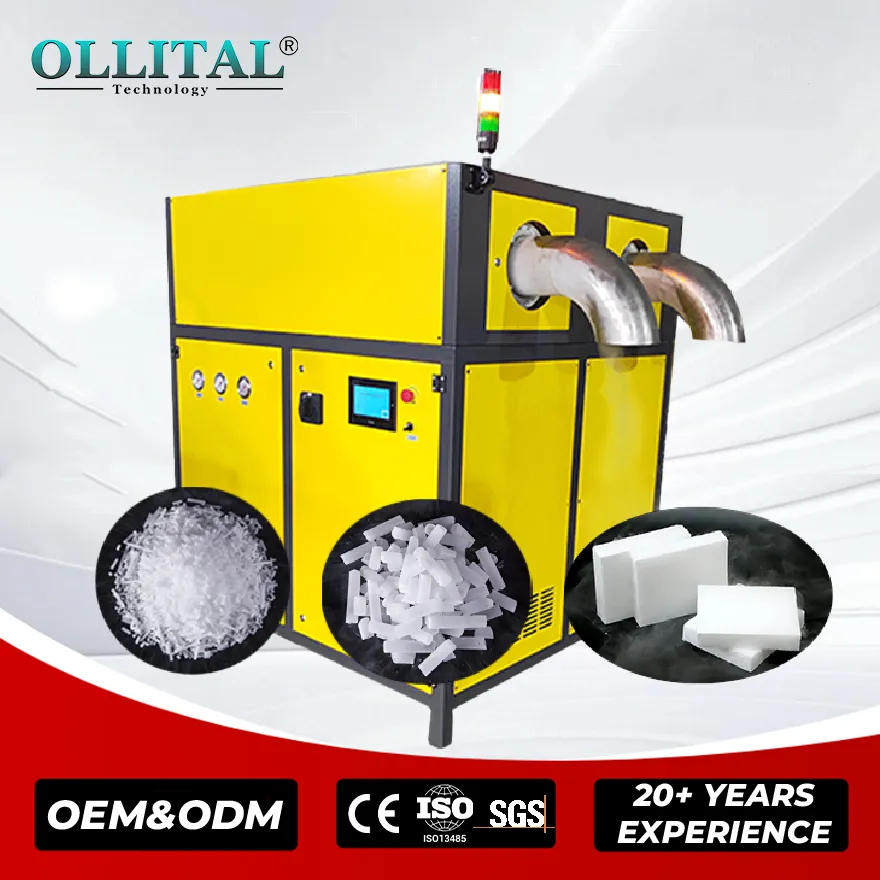
A current OLLITAL high-output dry ice production model. Actual selection should be based on real cleaning demand, operating hours and buffer requirements.
Several OLLITAL dry ice pellet machine pages currently list a liquid-to-solid CO₂ conversion ratio of ≥42% for the referenced models. That figure should be treated as a product-page reference for those configurations, not as a universal industry constant. Actual performance can depend on machine configuration, liquid CO₂ supply conditions and operating setup. Buyers comparing systems should therefore ask how output, liquid CO₂ consumption and recovery options are defined for the exact model being quoted.
Choosing Pellet Size for Dry Ice Blasting
For industrial cleaning, 3 mm dry ice pellets are commonly used as blasting media because they can be accelerated through dry ice blasting equipment and provide a practical balance between handling and cleaning energy. OLLITAL production-machine pages also list 16 mm pellets and customized pellet options on selected models. The correct size should be matched to the downstream use and the die configuration supplied with the production machine.
Pellet size should not be selected in isolation. Blasting equipment has its own acceptable media range. For example, the OLLITAL A625i industrial dry ice blasting machine is currently specified for granular dry ice in the approximately 2.5–3 mm range. When a production system is purchased specifically to support blasting, the pelletizer and the blaster should therefore be checked as one system rather than as separate purchases.
Fresh Dry Ice, Storage Time and Sublimation Loss
Fresh dry ice is valuable because every storage period introduces some loss. The goal is not necessarily to eliminate storage completely; in most real operations a buffer is useful. The goal is to keep the buffer appropriate for the production schedule so the site is not manufacturing far ahead of actual demand.
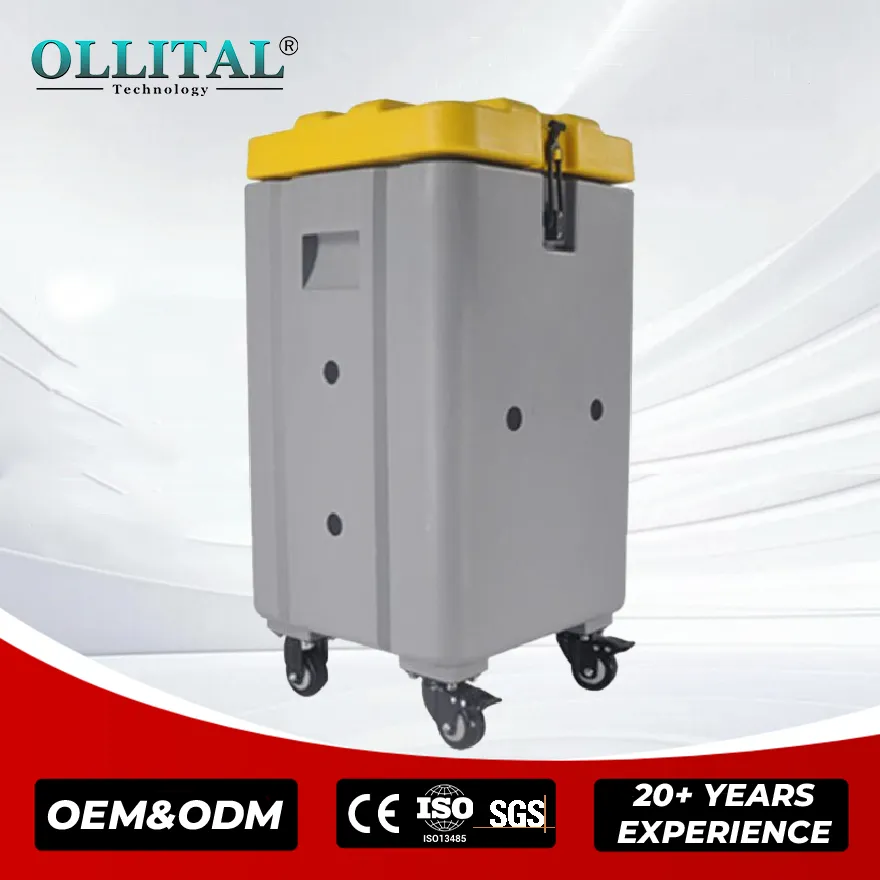
Insulated storage helps reduce heat transfer between production and use, but it does not eliminate sublimation.
An insulated dry ice storage box can help reduce heat transfer and make handling easier between the production area and the blasting point. It does not stop sublimation. Operators should still plan production timing, container opening frequency and internal handling so that pellets are used as efficiently as practical.
Building an On-Site Dry Ice Supply System
| Stage | Function |
|---|---|
| 1. Liquid CO₂ Supply | Stores and feeds liquid CO₂ to the production system. |
| 2. Dry Ice Production | Expands liquid CO₂, forms dry ice snow and compresses it into pellets. |
| 3. Buffer Storage | Holds short-term inventory between production timing and cleaning demand. |
| 4. Industrial Cleaning | Uses dry ice pellets in blasting equipment for maintenance and surface cleaning. |
A dependable on-site setup usually involves more than purchasing a pelletizer. The surrounding system may include bulk or local liquid CO₂ storage, suitable piping and pressure controls, the production machine, insulated temporary storage, material handling, and the blasting equipment itself. The exact arrangement varies by site and should be engineered around local requirements.
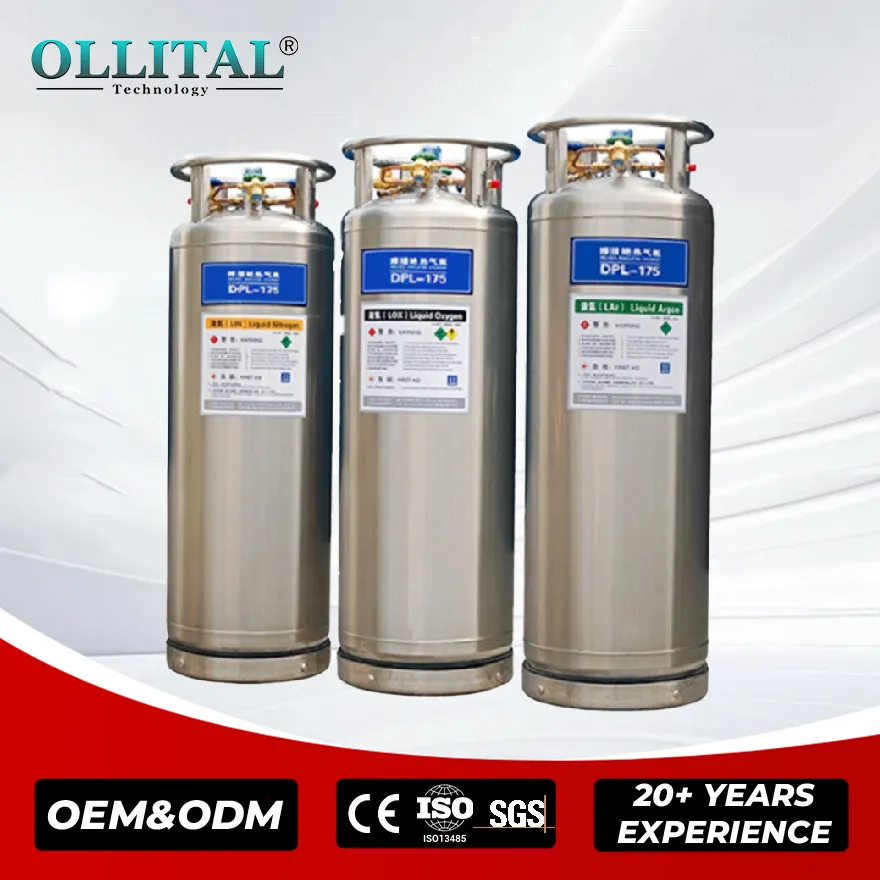
Upstream liquid CO₂ storage is one part of a complete on-site dry ice supply system. |
Downstream dry ice blasting equipment converts fresh pellets into cleaning work. The A625i currently lists 2.5–3 mm granular dry ice as its media specification. |


For upstream supply, OLLITAL also lists carbon dioxide storage tanks for liquid CO₂ applications. For downstream cleaning, the company’s dry ice blasting machine range includes industrial and precision-cleaning models. Connecting these pieces into one system can simplify project planning because the customer can evaluate CO₂ supply, pellet output and cleaning consumption together.
Questions the system design should answer
How many kilograms of dry ice are actually consumed per hour?
How many blasting machines may run at the same time?
How many hours per shift will blasting occur?
What pellet size does the downstream equipment require?
How far is the production area from the cleaning point?
How much buffer stock is needed?
What liquid CO₂ supply is available on site?
What space, ventilation and utility conditions are available?
Is future capacity expansion expected?
Will dry ice also be used for cooling, transport or other processes?
When On-Site Production Makes Sense — and When It May Not
On-site production is most compelling when dry ice is used regularly, delivery logistics are inconvenient, freshness matters, or the site wants more control over cleaning schedules. It may also be attractive when a facility has multiple cleaning shifts or a predictable recurring dry ice requirement.
However, producing dry ice in-house is not automatically the best option for every buyer. If consumption is very low, local dry ice supply is inexpensive and dependable, or the site does not have appropriate liquid CO₂ infrastructure and operating support, purchasing finished dry ice may remain simpler. The correct decision is a total-cost and operating-reliability comparison, not a general rule.
| Factor | Buying Dry Ice | Producing On Site |
|---|---|---|
| Initial equipment investment | Lower | Higher |
| Dependence on delivery schedule | Higher | Lower once the system is operating |
| Pellet freshness control | Depends on delivery and storage time | Production can be scheduled closer to use |
| Operating complexity | Lower | Requires CO₂ supply, operation and maintenance |
| Best fit | Low or irregular demand | Regular or higher-volume demand where utilization supports the investment |
What to Check When Selecting a Dry Ice Production Machine
Instead of comparing only the headline kg/h rating, buyers should evaluate the complete operating requirement. The most useful quotation request includes expected dry ice consumption, operating schedule, pellet diameter, liquid CO₂ source, available installation space, storage plan and whether multiple blasting machines will be supplied.
For OLLITAL’s current range, buyers can compare models through the Dry Ice Production Machine category. Representative product pages include the 50 kg/h pellet machine, 100 kg/h pellet machine, 250 kg/h production machine, 500 kg/h industrial machine, and 1000 kg/h large production machine.
Frequently Asked Questions
How much liquid CO₂ is required to make dry ice?
The answer depends on the liquid-to-solid conversion performance of the specific production machine and the actual supply conditions. Do not calculate liquid CO₂ demand from dry ice output alone. Ask the supplier for the conversion basis used for the quoted configuration and include any gaseous CO₂ handling or recovery arrangement in the calculation.
What size dry ice production machine is suitable for blasting?
Start with the dry ice consumption of the blasting operation. Estimate hourly demand, simultaneous blasters, operating hours, required buffer stock and expected storage loss. Then select a production capacity that can replenish that demand with a practical operating margin.
Can dry ice be produced next to the blasting machine?
Production can be located close to the cleaning operation when the facility layout and safety requirements allow it, but the final installation should consider liquid CO₂ handling, pressure-rated connections, ventilation, maintenance access, noise, workflow and local safety requirements.
What pellet size is normally used for dry ice blasting?
Approximately 3 mm pellets are commonly used in many dry ice blasting systems. Always confirm the accepted media size for the actual blaster. The A625i, for example, is currently listed for approximately 2.5–3 mm granular dry ice.
Is producing dry ice on site always cheaper than buying it?
No. The result depends on utilization, liquid CO₂ pricing, equipment investment, electricity, labor, maintenance, storage losses, delivery costs and local purchased-dry-ice prices. On-site production becomes more attractive when recurring demand is high enough to use the system effectively.
What equipment is needed besides the pelletizer?
A project may require liquid CO₂ storage or supply equipment, pressure control and piping, insulated dry ice storage, handling equipment and the downstream blasting machine. Requirements vary by installation, so the complete system should be reviewed rather than treating the pelletizer as a stand-alone appliance.
Can one production machine supply several dry ice blasters?
Yes, if the production rate and buffer strategy can cover the combined dry ice consumption of the blasting machines. Simultaneous operation and peak demand are more important than the simple number of blasters.
A More Practical Way to Think About Dry Ice Production for Cleaning
A dry ice production machine should not be viewed only as a machine that converts liquid CO₂ into pellets. In an industrial cleaning operation, its real role is to stabilize the supply side of the process. Production capacity, pellet size, storage time, conversion performance and blasting consumption all need to work together.
For some users, purchasing dry ice remains the simplest solution. For others, especially facilities with regular consumption and predictable cleaning schedules, on-site production can provide greater control over availability and pellet freshness. The best result comes from sizing the production system around actual cleaning demand rather than choosing a machine from capacity alone.
Planning an On-Site Dry Ice Supply System?Send OLLITAL your estimated dry ice consumption, number of blasting machines, operating hours, required pellet size, available liquid CO₂ supply and storage plan. Our team can help compare a suitable dry ice production machine, storage configuration and downstream blasting setup for your project. Explore Dry Ice Production Machines | Compare Dry Ice Blasting Machines |
| Related OLLITAL resources |