






A practical method for checking delivered dry ice, tracking storage shrinkage, and choosing a replenishment plan based on usable kilograms rather than nominal order weight.
When a site orders 100 kg of dry ice pellets, how many kilograms actually reach the cleaning crew, packaging operation or dispatch point? The difference is often treated as a vague handling cost. It should be measured. Dry ice sublimation loss begins while the product is in transit and continues during receiving, storage, transfers and use. An invoice weight, a storage box capacity and a production machine rating do not answer the same question.
At OLLITAL, we suggest separating these quantities before changing a supplier, buying larger dry ice storage boxes, or increasing production output. A short, repeatable measurement program can show where the losses occur and whether the better remedy is later delivery, improved insulation, fewer transfers or a different production schedule.
The Quick Answer: Measure Mass at Each Handoff
To estimate dry ice loss reliably, record the net dry ice mass, the time, and any additions or withdrawals at each relevant handoff: dispatch, receipt, storage entry, storage exit and final issue. Use a suitable weighing system and the correct container tare. Then reconcile the mass balance rather than simply comparing a delivery note with what happens to be left in the box hours later.
A single weight difference gives total unaccounted mass over an interval. It does not automatically prove that all of the difference was sublimation. Spills, samples, transfers, scale error, documentation differences and the mass of packaging materials can also affect the result. The audit becomes useful when these causes are separated.
1. Decide Which Loss You Are Trying to Explain
Three useful measures answer different operating questions:
Delivery loss: the difference between verified mass at shipment handoff and mass received, before the customer starts using the product.
Storage and handling loss: the change in on-site inventory after accounting for dry ice received, issued, returned and discarded during a defined holding period.
Usable yield: the mass that actually reaches the intended process or customer, divided by the appropriate starting mass for the same batch.
For outsourced supply, dispatch weight and receiving weight can clarify a transport problem. For a plant with an on-site dry ice production machine, measure the freshly collected batch and compare it with the dry ice issued to production or dispatch. Do not call this equipment conversion efficiency; conversion efficiency concerns how the incoming liquid CO₂ becomes collected solid CO₂, which is a separate measurement boundary.
2. Build a Receiving Check That Operators Can Repeat

A repeatable receiving check uses an identified container, suitable scale and recorded net mass; the pictured setup is illustrative.
Choose one receiving position with safe access, adequate ventilation and a scale suited to the expected gross weight. Weigh the container and contents together, subtract its known tare, and record the net dry ice mass. If the container tare includes a lid, pallet or removable liner, keep that definition consistent. Where a box sits on a separate pallet, the pallet needs its own tare or must remain unchanged across readings.
The receiving check should take place as promptly as practical after the handoff. Record the supplier and batch, pellet or block form, delivery time, quantity on the dispatch note, net measured mass, container identification and any visible abnormality. Note the condition of the dry ice: substantial fragments or powder in a pellet delivery, bridging, contamination, packaging damage or unusual handling conditions can matter even when the total weight is acceptable.
Do not delay receiving inspection to create a perfect data point. Keep the lid open only as long as the task requires, never handle dry ice with bare hands, and do not place dry ice in an airtight container. The purpose of the audit is to observe the normal operating process safely, not to create a new source of heat gain or exposure.
3. Calculate Loss Correctly: A Worked Example
Consider a hypothetical 20-hour holding trial. An operator measures 96.0 kg of net dry ice in a storage container immediately after receipt. No additional dry ice is added or removed. At the end of the trial, the same consistent tare method shows 90.0 kg remaining.
| Measurement | Illustrative value | Interpretation |
|---|---|---|
| Initial dry ice mass | 96.0 kg | Net mass at receiving |
| Final dry ice mass | 90.0 kg | Net mass after 20 hours |
| Observed loss | 6.0 kg | 96.0 − 90.0 kg |
| Observed loss fraction | 6.25% | 6.0 ÷ 96.0 × 100 |
| Average measured mass decrease | 0.30 kg/hour | 6.0 ÷ 20 hours |
The 6.25% result applies only to this illustrative interval and setup. It is not an OLLITAL storage-box performance claim, a guaranteed daily sublimation rate or a universal correction factor. Heat ingress and opening patterns vary over time, and a box that is nearly full may behave differently from the same box after much of its contents have been removed.
If dry ice is issued during the trial, the correct reconciliation changes: opening mass + received mass − issued mass − closing mass = unaccounted mass. Document any spill or deliberate disposal separately so it is not silently labeled as sublimation. The same approach can be applied to individual boxes or a defined storage area, as long as batches are not double-counted.
4. Compare Delivery Routes Without Mixing Boundaries
Suppose a shipment has a verified 100 kg net mass at dispatch, arrives with 92 kg at receiving, and is later issued with 87 kg available. The measured change during transit is 8 kg; the subsequent on-site decrease is 5 kg, assuming no undocumented additions or withdrawals. Total usable yield relative to dispatch is 87%. These figures are simple illustrations, not market benchmarks.
If the only starting figure is “100 kg ordered,” this calculation cannot precisely identify transit loss. The supplier may have weighed the batch before packing, used a different tare definition or taken the dispatch measurement at another time. Agree on the mass-measurement boundary before comparing carriers or challenging a delivery shortage.
For purchasing decisions, calculate cost per usable kilogram as the total relevant delivered cost divided by the dry ice actually issued for its intended use. For internal production, include the appropriate equipment, CO₂ supply, operating and handling costs; for delivered product, include freight and relevant receiving costs. A low quotation per invoiced kilogram is not necessarily the lowest cost per usable kilogram.
5. What Usually Drives Storage Loss?
Dry ice sublimates from solid CO₂ directly into gas. An insulated container slows heat entry, but it does not stop this process. The mass-loss pattern depends on the container and operating conditions, including:

Insulated storage and planned transfers can help reduce avoidable exposure; actual results depend on the selected container and workflow.
Container insulation and condition: lid fit, wall construction, damage and thermal bridges affect heat transfer. Insulation should be compared using matched field conditions, not brand claims alone.
Dry ice form and fragmentation: 3 mm pellets, larger pellets and blocks have different surface-area and handling characteristics; do not assume the same measured loss under otherwise different fill conditions.
Fill level and headspace: mass and temperature distribution change as a container empties. Compare similar starting loads where possible.
Ambient conditions and holding time: time in a warm dispatch corridor differs from time in a suitable sheltered staging area.
Opening and transfers: repeated access, unnecessary scooping and extended exposure can increase heat gain and product breakage.
The most useful trial changes one factor at a time. For example, compare identical storage periods before and after shortening the wait between receipt and issue. If several conditions change at once, it is much harder to identify why performance improved.
6. Choose a Storage Strategy From Actual Demand
The right dry ice storage box is not always the largest available. The goal is to bridge a known production, delivery or operating interval with enough usable dry ice while limiting unnecessary holding time and handling. A central buffer can support steady dispatch or several operators; smaller point-of-use boxes may reduce repeated trips and opening of the main reserve.
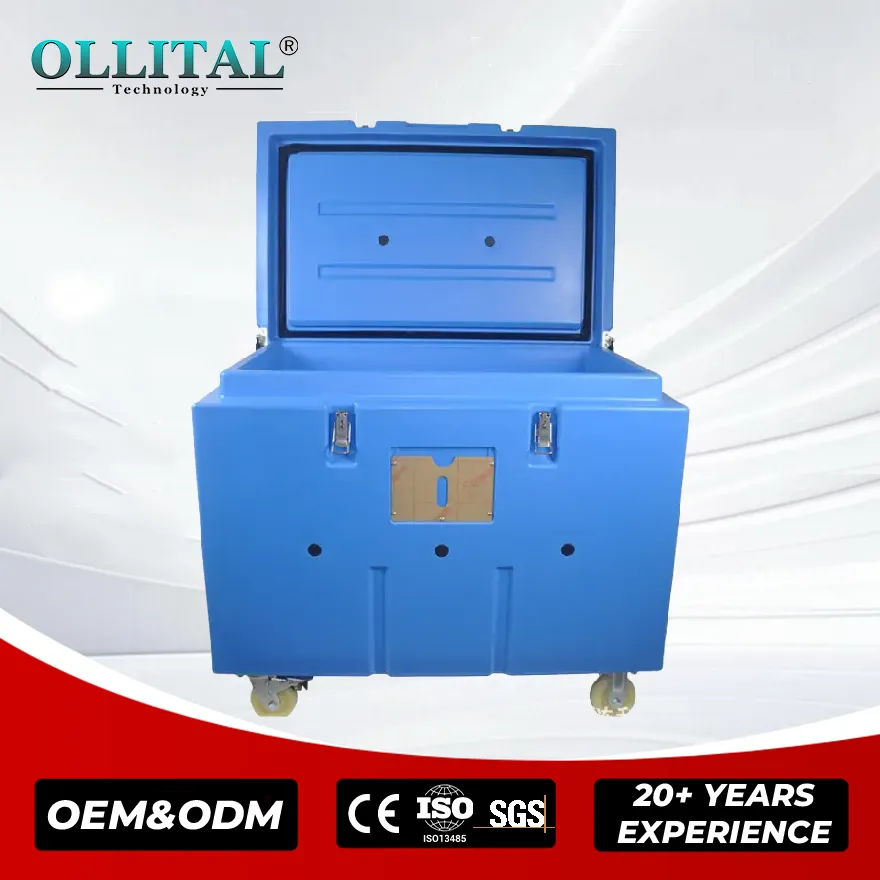
OLLITAL currently lists a 50 kg dry ice storage insulation box and a 270 kg large-capacity dry ice storage box. The published capacities refer to specified 3 mm granular dry ice configurations. They describe nominal capacity, not a promise that the dry ice will last a particular number of hours or that every application should load the box to its headline mass.
Before selecting a box, confirm its actual internal volume, handling weight, footprint, access method, site transfer route, the load it will carry and the manufacturer-approved approach to CO₂ gas release. An insulated container must never be modified into an airtight vessel. Where the operation is high-volume, a combination of central and point-of-use storage may be more useful than a single box chosen only from maximum capacity.
7. Turn the Audit Into a Replenishment Rule
A receiving log is valuable only if it changes how inventory is managed. Review the measured usable yield by delivery window, container, product form and intended process. Then set a practical replenishment approach around the work schedule rather than an unsupported universal “percent lost per day.”
For a blasting team using fresh 3 mm pellets, the relevant question is how much usable media will be present at the start of the cleaning shift. For a packaging line, the question is how long pellets will wait before packing and dispatch. For a customer buying blocks or pellets for a cooling application, the useful measure may be remaining mass at the point of loading or receipt. Each process requires its own handoff definition.
A strong weekly review compares measured yield, not only kilograms purchased. Keep the records simple: batch ID, time, net mass, tare definition, additions, withdrawals, operating notes and the disposition of any discrepancy. When losses are inconsistent, check measurement practices and actual handling first before assuming that a storage box or supplier has failed.
8. Keep the Measurement Safe
Dry ice is extremely cold and can cause cold burns on contact. Sublimated CO₂ is colorless and may accumulate in enclosed or poorly ventilated areas. The receiving, weighing and storage procedure must follow the site risk assessment, protective-equipment requirements and ventilation plan. Use suitable cold-protective gloves, eye protection and handling tools. Verify whether CO₂ monitoring is required for the quantities and room conditions involved.
Never seal dry ice inside a non-venting rigid vessel, never treat an ordinary refrigerator or freezer as an approved dry ice store, and do not enter a potentially CO₂-enriched enclosed space until it has been assessed and made safe. Shipping and transport also have separate packaging and ventilation requirements that depend on mode and jurisdiction. An inventory audit does not replace those controls.
Questions Buyers Commonly Ask
How long will dry ice last in an insulated box?
There is no reliable single number for every box, fill level and environment. Ask the supplier for the conditions behind any stated test result, and run a short matched trial using the product form and operating pattern that matter to your facility.
Can I estimate loss from a storage box’s rated kilogram capacity?
No. Rated capacity tells you the specified load quantity, not the actual sublimation rate. Insulation, handling, dry ice form, ambient conditions and storage duration all affect the outcome.
Why do my receiving records disagree with the supplier’s invoice?
The two weights may represent different measurement times or tare definitions, or there may have been genuine mass loss or a documentation error. Confirm the dispatch measurement method, time stamps and container/pallet taring before assigning the difference to transport.
Will producing dry ice on site eliminate storage losses?
No. On-site production can reduce the time between manufacture and use, but dry ice continues to sublimate after collection. Use a measured demand profile to evaluate whether on-site dry ice production equipment is appropriate for your operation.
Conclusion: Buy and Plan Around Usable Dry Ice
Dry ice loss is not just a storage issue. It is the result of several measurable handoffs, from production or dispatch to receiving, short-term storage and actual use. A simple mass-balance audit can show whether the main opportunity is faster delivery, better scheduling, fewer transfers or a more suitable storage arrangement. The useful number is not only what was ordered; it is what remains available when the work begins.
At OLLITAL, we work with buyers planning the relationship between dry ice production machines, insulated storage and downstream handling. If you are evaluating a new line or trying to reduce loss in an existing operation, the starting point should be the real product form, batch size, receiving timetable and working demand. Our dry ice production facility layout guide can also help connect storage to the rest of the workflow.
Want to review your dry ice storage and replenishment plan?
Send us your dry ice form, typical daily volume, delivery or production schedule, storage time and available handling space. We can discuss relevant equipment options and the operating information needed for a meaningful comparison. Contact OLLITAL.