



Dry ice does not behave like ordinary frozen inventory. From the moment it is produced, it begins to return directly to carbon dioxide gas through sublimation. That means a business can manufacture or purchase the correct quantity of dry ice and still discover that the usable amount is lower by the time the material reaches the application. For companies using dry ice for industrial cleaning, food logistics, process cooling, laboratory work, transportation or resale, storage loss is therefore not a minor housekeeping issue. It is part of production planning, operating cost and supply reliability.
The most practical way to manage storage loss is not to chase a single universal sublimation percentage. Real loss depends on the dry ice form, container insulation, ambient temperature, how often the lid is opened, how full the container is, how long the material waits before use and how many times it is transferred. A better approach is to understand the main loss mechanisms, select the smallest practical insulated container for the job, measure real loss under your own conditions and plan inventory around when the dry ice will actually be used.
Why Dry Ice Storage Loss Matters
Storage loss changes more than the number of kilograms left in a container. It affects how much liquid CO₂ must be purchased, how much machine time is required, how large the production buffer should be and whether the downstream process receives the amount of dry ice it expects. If a site produces 500 kg but only 450 kg remains available when the material is actually consumed, the cost of the missing 50 kg has already been paid in raw material, production time, electricity and handling.
This is especially important when production and use happen at different times. A plant may produce dry ice during the morning, store it through the day and consume it during a later cleaning shift. A distributor may manufacture pellets or blocks in one location and deliver them to customers several hours later. A cold-chain operation may need dry ice to remain available through packing, staging and transport. In each case, the storage interval becomes part of the usable-output calculation.
What Sublimation Actually Means in Storage
Dry ice is solid carbon dioxide. Under normal atmospheric conditions it does not melt into a liquid puddle; it changes directly from solid CO₂ into gas. That process is called sublimation. An insulated storage container slows the rate at which heat reaches the dry ice, but it cannot stop the process completely. As long as heat enters the container, some dry ice will continue to become gas.
The goal of storage is therefore not to create a permanent zero-loss environment. The goal is to reduce unnecessary heat transfer, keep handling efficient and shorten the time between production and use. That is why the best storage strategy is usually operational rather than purely mechanical: good insulation helps, but good scheduling matters just as much.

Dry ice sublimation is influenced by ambient heat, lid opening, exposed surface area, storage time and how effectively the container is filled.
The Main Factors That Increase Dry Ice Loss
• Ambient temperature: A warmer surrounding environment increases the temperature difference between the dry ice and the room, increasing heat flow into the storage container.
• Frequent lid opening: Every opening allows warmer air to enter and disturbs the cold internal environment. Repeated checking or unnecessary access can increase loss.
• Small dry ice pieces: Small pellets expose more surface area relative to their mass than large blocks. This is one reason pellets can sublimate faster than larger pieces under similar storage conditions.
• Long holding time: Even a well-insulated container cannot eliminate sublimation. The longer the dry ice waits before use, the more material will be lost.
• Partially filled containers: A container with a small quantity of dry ice and a large amount of empty space can be less efficient than a right-sized container filled closer to its intended working level.
• Repeated transfer: Moving dry ice between open bins, weighing stations, bags and storage boxes creates additional exposure to ambient heat.
Why There Is No Reliable Universal Storage-Loss Percentage
It is common to see simple statements that dry ice loses a fixed percentage per day. Those figures may be useful as rough examples, but they should not be treated as a guaranteed rule for every plant. Loss can change significantly with container construction, dry ice size, fill level, room temperature, airflow, opening frequency and the time between production and use.
For a commercial operation, the most useful number is not an industry-average percentage. It is the measured loss under the site's actual working conditions. A business that produces pellets into an insulated box and uses them within two hours will have a different loss profile from a business that stores dry ice overnight, loads it into a vehicle and delivers it several hours later.
Measure Real Storage Loss at Your Own Site
A simple storage-loss test can provide much better planning data than a generic assumption. The test does not need to be complicated. Use the same dry ice form, container, loading quantity and handling method that the operation normally uses, then measure the mass at defined time intervals.
| Measurement Step | What to Record | Why It Matters |
|---|---|---|
| Initial loading | Starting mass, dry ice form, container type, fill level | Creates a reliable baseline |
| Storage condition | Room temperature, indoor / outdoor location, lid status | Explains environmental influence |
| Access pattern | Number and duration of lid openings | Shows the effect of handling |
| Intermediate check | Remaining mass after 1, 2, 4 hours or another useful interval | Builds a time-based loss profile |
| Final use | Mass actually available at the application | Provides the most useful operational number |
Repeating this test during different seasons or operating conditions can be useful because storage behavior in a cool workshop may not be identical to storage in a hot loading area. Once the business has its own data, inventory planning can use measured loss rather than a generic safety factor.
Choosing the Right Dry Ice Storage Container
Container selection should begin with three practical questions: how much dry ice needs to be stored, how long it will remain there and how the container must be moved or accessed. The best container is not necessarily the largest or most heavily insulated unit available. A very large container holding a very small quantity of dry ice may be less practical than a smaller box that is easier to keep reasonably full.

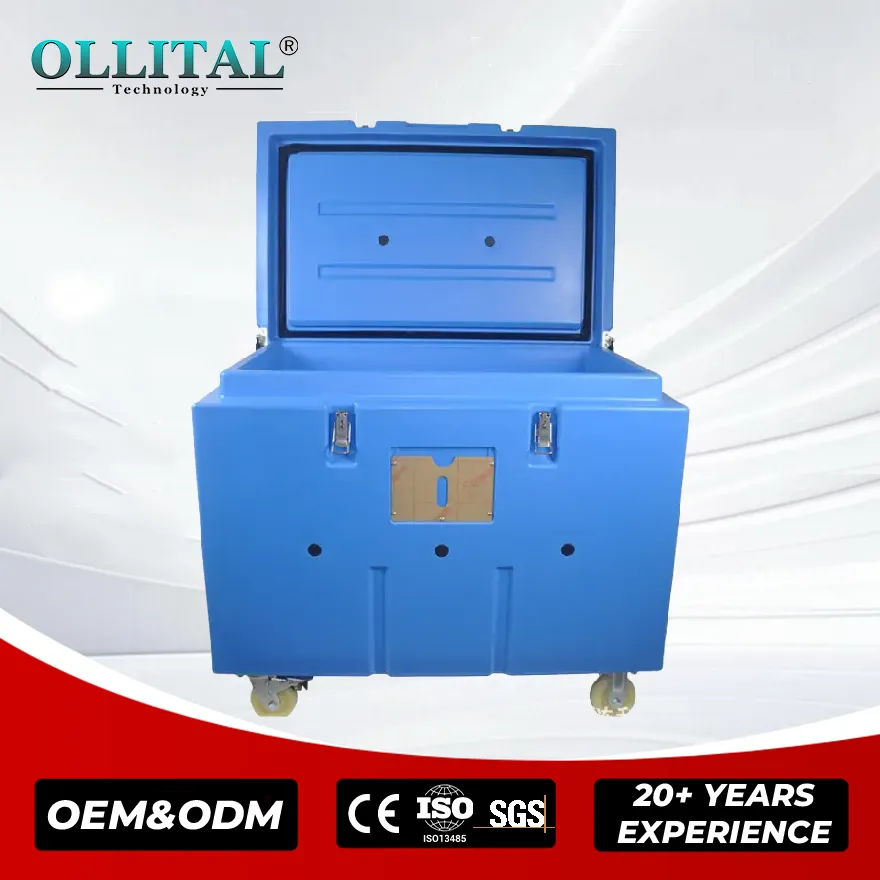
Storage options range from open transfer bins to insulated boxes and larger industrial containers. The correct choice depends on holding time, quantity and handling requirements.
Open Bins: Useful for Transfer, Poor for Storage
An open plastic or stainless bin can be useful for very short transfer steps, such as collecting dry ice directly from a machine or moving product from one workstation to another. It should not be confused with an actual storage solution. Open containers provide little protection from heat transfer and allow continuous exchange with the surrounding air.
If an open bin is necessary in the workflow, the best strategy is to minimize the time the dry ice remains there. The bin should function as a transfer point, not as a buffer that holds product for long periods.
Insulated Storage Boxes: Practical for Daily Buffer Stock
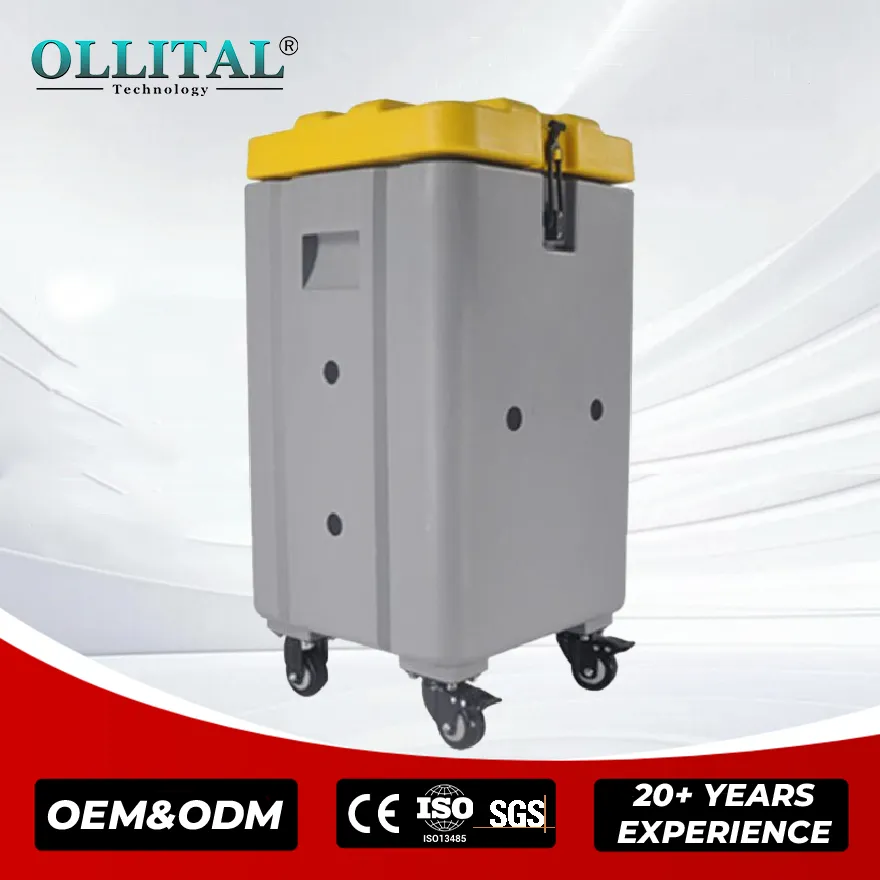
For many industrial users, an insulated box offers a practical balance between insulation, mobility and access. OLLITAL currently lists a dry ice storage insulation box intended for short-term storage and handling. A box of this type is useful when dry ice must bridge the gap between production and use without becoming a permanent long-term inventory.
The key advantage is not that an insulated box prevents sublimation. It does not. The advantage is that the container reduces unnecessary heat transfer compared with an open bin and keeps the product easier to move, stage and protect during normal plant handling.
Large Insulated Containers: Useful When Volume and Logistics Increase
Higher-volume operations may need larger insulated bins or pallet-style containers, especially when dry ice is being prepared for distribution, multiple production lines or large internal users. These containers can reduce handling frequency and support larger batch sizes, but they should still be matched to the real inventory level.
A large container can become inefficient if the operation repeatedly stores only a small amount inside it. The better practice is to use container sizes that fit the normal load profile and to avoid creating more empty space than the process needs.
Pellets and Blocks Do Not Store the Same Way
The physical form of dry ice influences storage behavior. Small pellets expose more total surface area for the same mass than large blocks, so they can lose mass faster under comparable conditions. This does not make pellets a poor choice. Pellets are often the correct format for dry ice blasting, flexible packing and process cooling. It simply means that pellet production benefits from shorter storage time and faster turnover.
If your operation is still deciding between these output formats, the earlier guide Dry Ice Pelletizer vs Dry Ice Block Machine explains how application, handling and storage needs influence the equipment decision. The most useful approach is to choose the dry ice form for the application first, then build storage and inventory planning around that form.
Keep Containers Closed, but Never Treat Dry Ice Storage as Airtight
Dry ice continuously releases CO₂ gas. Storage containers should therefore be designed for dry ice service and should not be sealed as pressure vessels. A rigid airtight container can allow gas pressure to build as sublimation continues. Use containers intended for dry ice and follow the manufacturer's handling instructions.
Ventilation around dry ice storage is also important because carbon dioxide gas can displace oxygen in enclosed or poorly ventilated spaces. Workers should avoid storing large quantities of dry ice in unventilated rooms, vehicles or small enclosed areas. Direct skin contact should also be avoided because the extremely low temperature can cause cold injury.
Inventory Planning: Produce or Buy for the Time of Use
The easiest way to reduce storage loss is to reduce storage time. That sounds simple, but it changes the way dry ice inventory should be managed. Instead of asking how much dry ice can be stored, ask how much dry ice must be available at a specific time. Then schedule production or delivery backward from that requirement.

A faster-turning inventory plan reduces unnecessary holding time by connecting production, transfer, buffer storage and final use more closely.
A Five-Step Inventory Approach
• 1. Produce: Base production on confirmed demand, a realistic near-term forecast and the known operating schedule rather than filling storage simply because production capacity is available.
• 2. Transfer: Move dry ice quickly from the production machine or receiving point into the correct insulated container. Avoid unnecessary open-bin waiting.
• 3. Buffer: Keep only a right-sized short-term buffer that protects the operation from normal variation without creating excessive stored inventory.
• 4. Use or dispatch: Schedule cleaning, packing, loading or customer dispatch as close as practical to production so the material spends less time waiting.
• 5. Review: Compare planned inventory with actual remaining mass, record the difference and use the data to adjust the next production cycle.
How Much Buffer Stock Should You Hold?
There is no single correct buffer quantity. The right amount depends on how predictable demand is, how quickly additional dry ice can be produced or purchased, the consequence of a shortage and the expected storage loss during the buffer period.
A business with an on-site production machine and a stable liquid CO₂ supply may be able to keep a smaller dry ice buffer because new material can be produced when needed. A site that depends on external delivery may need more safety stock to protect against transport delays. The trade-off is that a larger buffer also creates more time for sublimation.
Practical planning logic: Required production = usable demand + planned short-term buffer
The buffer should be deliberate, not accidental. It should exist because the operation has identified a specific lead-time or demand risk, not simply because there is unused storage space.
Storage Loss Should Be Included in Production-Cost Calculations
Every kilogram lost during storage has already consumed raw material and production resources. For an on-site plant, that includes liquid CO₂, electricity, machine time and labor. For purchased dry ice, the lost material has already been paid for in the delivered price. That is why storage loss should be included when calculating the real cost of usable dry ice.
For a more complete cost framework, see Dry Ice Production Cost Per Kilogram. The useful denominator is not the amount that left the production machine or arrived from the supplier; it is the amount that actually remains available for the application.
Storage Planning for Different Operating Models
| Operating Model | Storage Priority | Practical Direction |
|---|---|---|
| On-site dry ice blasting | Fresh pellets near the cleaning schedule | Produce close to use and keep only a short operational buffer |
| Food / cold-chain packing | Enough inventory for packing and dispatch windows | Coordinate production or delivery with packing schedule |
| Commercial dry ice distribution | Protect product through staging and transport | Use larger insulated containers and rapid dispatch |
| Laboratory / process cooling | Small quantities available when experiments or batches start | Use right-sized boxes and avoid large excess stock |
| Multi-shift industrial use | Reliable handover between shifts | Measure shift-to-shift loss and size buffer accordingly |
A Practical Dry Ice Storage Checklist
• Use a container designed for dry ice service.
• Match container capacity to the normal quantity being stored.
• Keep lids closed except when access is genuinely required.
• Move dry ice out of open transfer bins as quickly as practical.
• Store the container in the coolest practical, well-ventilated area available.
• Avoid direct sun, heaters and unnecessary warm-air exposure.
• Do not use an airtight rigid container that can build pressure from CO₂ gas.
• Keep the storage area adequately ventilated.
• Use suitable protective gloves and handling tools for direct dry ice handling.
• Record starting and remaining mass when building your site's loss model.
• Separate old and new inventory when useful for stock control.
• Plan production and dispatch around actual time of use rather than maximum storage capacity.
FAQ
Why does dry ice lose weight in storage?
Dry ice sublimates directly from solid CO₂ into gas. Heat entering the storage container provides the energy for that process, so the material gradually loses mass even when stored in an insulated box.
Can a dry ice storage box completely stop sublimation?
No. Insulation reduces heat transfer but cannot eliminate it. The best strategy combines good insulation with short storage time, limited lid opening and efficient inventory turnover.
Do dry ice pellets sublimate faster than blocks?
Small pellets generally expose more surface area relative to their mass than large blocks, so they can lose mass faster under comparable storage conditions. The actual difference still depends on container and environment.
Should dry ice be stored in an airtight container?
No. Dry ice releases CO₂ gas continuously. A rigid airtight container can develop dangerous pressure. Use containers designed for dry ice storage and follow the manufacturer's instructions.
How much dry ice should I keep as buffer stock?
The correct buffer depends on demand variability, how quickly new dry ice can be produced or delivered, and the cost of a shortage. Keep the buffer purposeful and as short-turning as the operation reasonably allows.
How can I calculate my actual storage loss?
Weigh the dry ice when it enters the container, record storage time and handling conditions, then weigh the remaining amount at the point of use. Repeat the test under normal operating conditions to build a reliable site-specific loss profile.
Where should a dry ice storage container be placed?
Place it in a cool, dry and well-ventilated area that is convenient for the workflow but away from unnecessary heat sources and direct sunlight. The location should also support safe CO₂ ventilation.
Conclusion
Dry ice storage loss is not something that can be eliminated with a larger box or a single rule-of-thumb percentage. It is the result of heat transfer, dry ice form, container design, handling and time. The most effective storage strategy combines suitable insulation with fast inventory turnover and site-specific measurement.
If you are planning a dry ice production and storage workflow, OLLITAL's dry ice storage solutions and dry ice production equipment can be evaluated together so production quantity, temporary storage and downstream use are planned around the same operating schedule.
Need help planning dry ice storage and inventory for your operation?
Tell us your dry ice form, daily demand, expected holding time and application, and we can help you review a practical storage and production configuration.