





An operator-focused field guide to keeping insulated dry ice containers practical, safe and ready for the next shift.
The answer in one minute
At OLLITAL, we encourage customers to treat a dry ice storage box as working equipment, not simply a place to leave cold material. A quick pre-use inspection, gentle cleaning after the box is empty, attention to lid and wheel condition, and a clear method for safe CO₂ gas release can prevent many avoidable handling problems. An insulated box slows heat entry; it does not stop dry ice from sublimating, and it must never become an airtight pressure vessel.
The most useful maintenance routine is therefore simple: look at the lid and contact surfaces, inspect the body for damage, verify latches and mobility hardware, keep the interior clean and dry, and confirm that the location and container configuration remain suitable for dry ice. When a component looks abnormal, compare it with the manufacturer-approved design before adjusting, repairing or replacing anything.
Start each shift with a two-minute walkaround
The checklist below is designed for operators receiving a filled box, moving it to a work area, or preparing it for a collection or delivery window. It is a visual check, not a substitute for the product instructions or your site’s safety procedures.
Check point | What to look for | If something is wrong |
|---|---|---|
Lid and rim | Lid sits evenly; no trapped debris or obvious deformation. | Stop and clean the rim; investigate distortion or damage. |
Gasket or contact strip | Where fitted, no tears, detached sections or heavy contamination. | Do not improvise an airtight seal; request correct parts. |
Latches / hinges | Hardware moves normally without forcing or unusual looseness. | Keep the box out of service if the lid cannot be secured as designed. |
Wheels / base | Casters roll and swivel normally; brakes work where fitted. | Do not move a loaded box with a defective wheel or unstable base. |
Body and handles | No cracks, deep impact marks or loose fittings. | Document and assess before loading or moving. |
Work area | Ventilated, accessible, stable floor; designated handling route. | Relocate or obtain a site safety assessment. |
Lid care: good contact without unsafe pressure buildup
A damaged lid or distorted rim can increase heat ingress and make a box awkward to open. At the same time, better insulation does not mean gas-tight closure. Dry ice changes directly into carbon dioxide gas during storage. A container must permit gas to escape by the intended design; a latch, gasket or supplementary cover must never be modified in a way that traps that gas.
When our customers ask us whether a lid gasket should be replaced, we recommend starting with the actual part condition. Check for cuts, permanent flattening, deformation, contamination and detached sections. Look for abrasion on the lid rim and uneven closure. If the contact surface is dirty, clean it using a compatible method after the box is empty and at a safe handling condition.
Do not fit household weatherstripping, tape over joints, glue the lid shut or block any designed gas-release path. If you are unsure how the specific model vents, stop using it for dry ice until the configuration is confirmed. The correct lid fit and safe venting arrangement must work together.
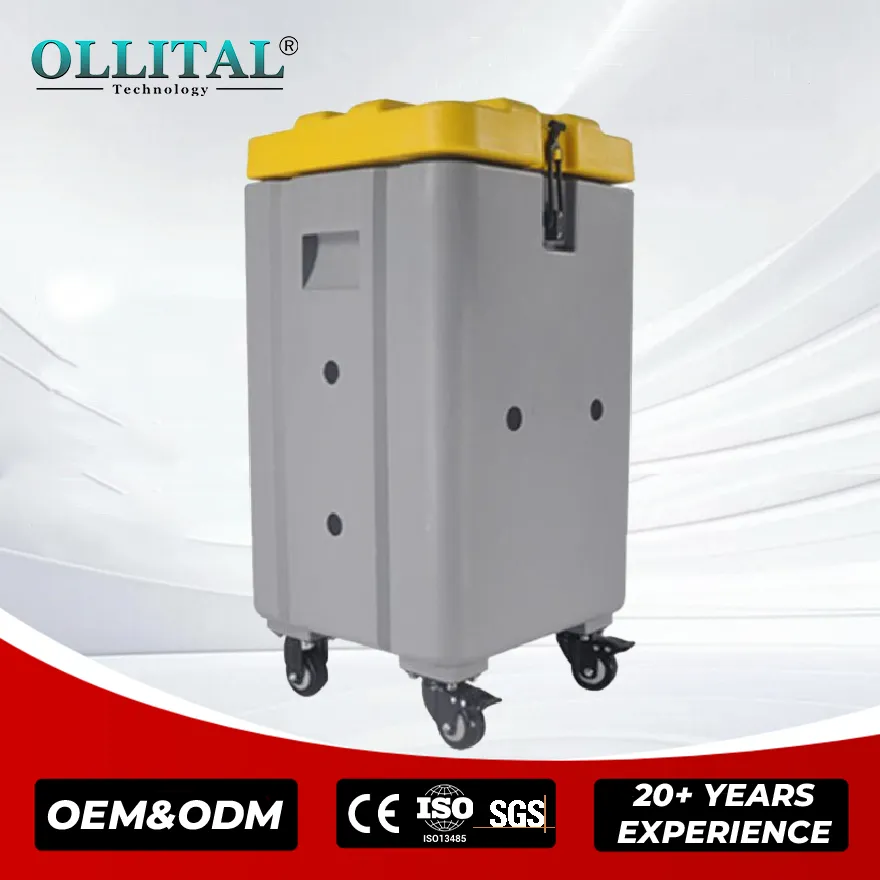
Product detail: gray body with yellow insulated lid
| What to inspect on this lid design • Open lid and inside perimeter • Visible white contact strip • Hinge and front metal latch • Molded side handhold and outer wall • Interior corners before refilling |

Lid and hardware arrangement shown for illustration. Inspect the exact supplied configuration.
Casters, brakes and the bottom of the box
A caster problem is sometimes noticed only after a heavy box is already in motion. We recommend checking the floor-contact components before filling or relocating the container. Examine wheel tread, swivel movement, mounting bolts and any brakes provided with that particular model. Uneven rolling, wobble, grinding sounds or a seized swivel are reasons to stop and inspect.
A full dry ice storage box is not a convenient place to test a weak wheel. Follow the box’s rated loading and handling instructions and use approved material-handling equipment where required. Never lift a loaded box by decorative lid edges, uncertain attachment points or parts not intended to support the weight.
For designs with molded feet rather than casters, inspect the ground-contact surfaces for cracks, uneven support or signs of impact. Parking and transport arrangements should suit that specific base design; a fixed-foot container and a wheeled box do not have interchangeable handling methods.
Clean the container after use, not while it is full
The right time for most interior cleaning is after the dry ice has been used or safely removed, when the container can be handled under the site’s procedure. Dry ice is extremely cold, so avoid reaching into a loaded box without suitable insulated gloves and tools. Never use a water wash as a quick way to dispose of remaining dry ice, and do not close wet tools inside a box that is about to be reloaded.
For normal dirt on a compatible PE outer and inner surface, use a gentle cleaning method approved for the container material. A soft cloth and a compatible mild detergent may be suitable, followed by thorough rinsing where permitted and complete drying. Aggressive solvents, abrasive pads, uncontrolled hot-water treatments, pressure washing around vulnerable fittings and improvised repairs can damage surface finishes, gaskets or hardware.
If boxes are used around food, laboratories or regulated shipments, apply the customer’s documented hygiene and changeover procedures as well. The right cleaning agent, required contact time and inspection method depend on the application and the container’s material specifications; do not assume one generic chemical is appropriate for every operating environment.
Venting and location: the safety check that cannot be skipped
A well-insulated dry ice box still releases CO₂ gas as its contents sublimate. CO₂ is colorless and odorless; it can accumulate in poorly ventilated spaces, especially lower or enclosed areas. We advise customers to evaluate the entire location—not just the box. A room, pit, enclosed vehicle or container-loading area may require ventilation controls, monitoring and a documented risk assessment before dry ice is stored there.
Never make a dry ice container airtight. Never block or alter a manufacturer-designed relief or gas-release arrangement. If a box has latches or a gasket, that does not by itself prove it is intended to hold pressure. Proper storage means using a box expressly suitable for dry ice, following its approved configuration and keeping the surrounding space safe for people.
Operators also need protective gloves suited to very cold materials and appropriate eye protection when handling dry ice. Any gas alarm, breathing discomfort, suspected excessive CO₂ buildup or abnormal pressure condition calls for the site’s emergency procedure, not a quick lid adjustment by an unprotected worker.
When insulation performance seems worse, investigate before blaming the material
If a familiar storage box seems to lose dry ice more quickly, we suggest checking the operating circumstances before assuming the insulation has failed. Have holding times changed? Is the box opened more frequently? Is it positioned in warmer surroundings? Was the lid left ajar, or was a large amount of dry ice placed in a much larger empty cavity? Are products being loaded warmer, or transferred repeatedly? These differences can affect usable dry ice even when the container itself is intact.
Compare results under similar conditions and, where practical, weigh dry ice at the start and end of a defined holding period. Do not publish a single generic “loss per hour” figure for every box: sublimation depends on fill level, dry ice form, ambient conditions, opening frequency and the specific container. If a clear change remains after operational conditions are controlled, inspect the lid, corners, outer shell and any areas showing new impact damage.
Troubleshooting: what the symptom is telling you
Observed symptom | First checks | Recommended response |
|---|---|---|
Lid no longer closes evenly | Debris, warped contact surface, hinge alignment, worn hardware | Clean and inspect empty box; confirm proper replacement parts. |
Frequent dry ice top-ups | Opening frequency, dispatch timing, fill level, lid use, warmer room | Measure comparable holding periods; optimize process first. |
Box difficult to move | Caster wear, floor condition, overload, wheel damage | Stop movement; inspect and service per approved procedure. |
Water or residue after changeover | Incomplete drying, cleaning method, condensation | Clean and dry fully before the next fill; follow site hygiene procedure. |
Unexpected body crack or lid gap | Transport impact, incorrect handling, material damage | Remove from service if integrity is uncertain; seek manufacturer assessment. |
Concern about gas release | Venting arrangement, room ventilation, monitoring, blocked route | Do not seal the box; stop and obtain a site safety assessment. |
A practical maintenance rhythm
We prefer maintenance intervals based on actual duty rather than arbitrary calendar promises. A box moved repeatedly on rough floors needs more frequent caster attention than one parked in a stable, clean environment. Use the following rhythm as a starting framework, then adapt it to operating experience and the model-specific instructions.
When | Focus | Record |
|---|---|---|
Before every use | Lid, body, handles, latches, safe venting and work location | Simple pre-use pass/fail |
After use / each changeover | Empty safely; remove residue; clean and dry; look for new impacts | Cleaning sign-off / exceptions |
Routine planned check | Casters/feet, hardware, contact surfaces, condition trends | Photographs and repair actions |
After transport damage or incident | Full integrity check; isolate questionable containers | Inspection and return-to-service approval |
Match care to the actual box, not only its nominal capacity
OLLITAL supplies more than one dry ice storage configuration. Our 50 kg dry ice storage box is listed with a 60 L usable internal volume, while our 270 kg dry ice storage box is listed at 330 L. Both are presented with rotomolded PE construction and PU foam insulation. The appropriate handling method still depends on the exact lid, latch, base and accessory configuration supplied.
A larger box can concentrate more product and may reduce repeated transfers, but it also changes loading weight, movement and access requirements. A smaller box may be easier to place near the user, yet can require more replenishment in busy operations. For detailed buffer planning rather than maintenance, our production facility layout guide can help organize the operating decision.
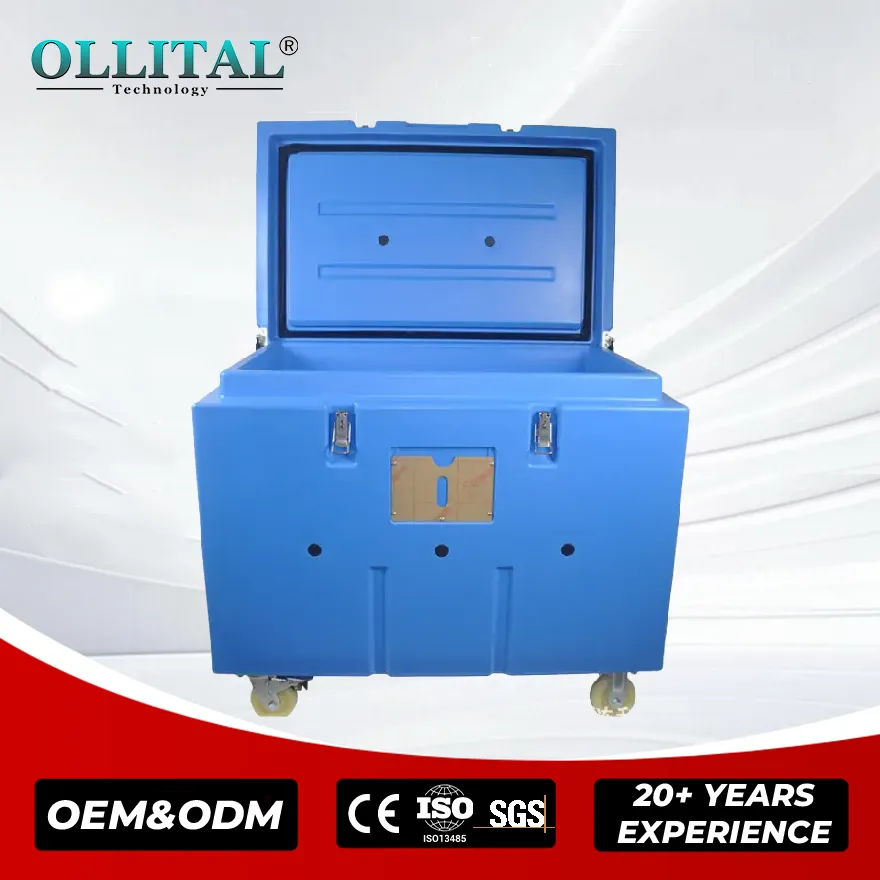
Product detail: larger blue wheeled storage style
| Inspection points on this wheeled box design • Lid interior and hinge articulation • Front latch engagement points • Interior walls and corners • Side handles and molded panels • Visible casters and wheel condition |

Inspection areas illustrated; individual hardware and accessories vary by model.
What to ask when you need replacement components
To avoid ordering the wrong lid, latch or wheel, send us the box model, photos of the affected area, approximate age or purchase reference, and a description of the problem. For a caster, include the wheel and mounting arrangement. For a lid issue, show the entire opening and the hinge/latch sides. We can then help clarify the available configuration and the information required for a parts inquiry.
We do not recommend choosing replacements solely by visual resemblance. A slightly different caster mount, gasket profile, latch throw or lid shape can create poor fit or unsafe use. Exact compatibility should be confirmed before fitting.
Questions operators often ask
Can we close the lid tightly to keep more cold inside?
Close and secure the lid only as the dry-ice-approved design permits. Never make the box airtight or obstruct its gas-release path. Dry ice must be able to release carbon dioxide safely.
What if we notice a crack in the outer shell?
Remove the box from use if integrity may be affected. Document the crack and contact the supplier for assessment; do not rely on an improvised patch for a loaded container.
How often should we replace a lid gasket?
There is no universal replacement interval. Check the specific gasket or contact component for damage, contamination, compression or loss of fit, then follow the model-specific maintenance guidance.
Should the inside be washed immediately after dry ice is removed?
Clean only when the container is in a safe condition for handling and the dry ice has been properly removed or used. Follow approved material-compatible cleaning and drying instructions.
Does a lid gasket mean the box can hold pressure?
No. A lid contact strip intended to reduce heat entry is not proof that the container is a pressure vessel. Safe CO₂ gas release remains essential.
Can we replace casters with a larger wheel?
Not without confirming load rating, mounting compatibility, clearance and the manufacturer-approved configuration. Improper wheel changes can affect stability.
Why is dry ice disappearing faster even though the box looks undamaged?
First compare ambient conditions, fill level, opening frequency and holding time. If the change remains under comparable conditions, inspect the box and request assistance.
What information should we send OLLITAL for a maintenance question?
Share the box model, overall and close-up photos, the part or symptom involved, and the operating situation. Those details make troubleshooting and parts matching more precise.
Keep the box ready for the next shift
A good maintenance routine protects the practical value of an insulated container: reliable handling, cleaner changeovers, repeatable working stock and safer day-to-day operation. At OLLITAL, we recommend starting with the small checks an operator can complete before each use, documenting exceptions and correcting wear before it becomes a handling interruption.
If your current boxes are being moved between production, packaging and dispatch, it may also be useful to review how storage turnover and handling routes influence dry ice usage. See our packaging line workflow guide for the broader process perspective.
Need help checking a storage-box configuration or identifying a replacement part?
Send us your model, photos, intended loading pattern and any observed damage. We can discuss suitable next steps and the information needed for a configuration review. Contact OLLITAL.