






An OLLITAL buyer guide to diameter, media compatibility, material flow and real-world handling
Quick Answer: Start With the Job, Not the Diameter
If your main application is dry ice blasting, the first question is the exact pellet diameter accepted by your blasting machine. Many dry ice blasters are designed around approximately 3 mm granular dry ice; larger 16 mm or 19 mm pellets should not be fed into a machine unless that model explicitly accepts them. For cooling, buffer storage or industrial material handling, larger pellets may be worth evaluating because their shape can suit different feeding and portioning methods. The practical choice still depends on pellet length, breakage, packaging, holding time, container geometry and actual operating conditions.
At OLLITAL, we prefer to begin with how the dry ice will be used after it leaves the production machine. The same facility may need fine blasting media on one shift and larger cylindrical pellets for a separate cooling or distribution task. Our aim is to help buyers specify the right dry ice pellet size for each downstream process, rather than treating one diameter as automatically superior.
Why 3 mm, 16 mm and 19 mm Are Not Interchangeable
A diameter is a useful starting specification, but it is only one dimension of the product. Two batches called “16 mm dry ice” may behave differently if their pellet lengths, density, surface condition, fines content or handling history differ. Similarly, a 3 mm pellet that has fragmented into powder is not equivalent to fresh, consistent 3 mm material. A good purchase specification describes not only the nominal diameter but also the usable condition of the ice on arrival.
The difference becomes clear at equipment interfaces. A blasting hopper and feeder must meter pellets through a defined media path and accelerate them through a nozzle; oversized pellets can bridge or obstruct a system not designed for them. A packaging or weighing line has different concerns: whether the pellets flow, settle and release consistently without excessive damage or cold-related film problems. A storage box must provide enough working volume and safe CO₂ release for its actual load and handling method. One diameter cannot be selected correctly without these interfaces.
A Practical Buyer Comparison
Pellet diameter | First application to evaluate | Critical compatibility check |
|---|---|---|
3 mm | Dry ice blasting, fine metering, smaller granular fills | Blaster approved media range; dry ice quality; powder/fines; hopper feed |
16 mm | Bulk cooling, industrial holding or packing tasks needing larger cylinders | Weighing / dispensing method; pellet length; packaging and box loading |
19 mm | Selected cooling and manual/bulk handling arrangements | Whether the actual production model offers the die; downstream handling and pack fit |
This is a selection starting point, not a universal performance ranking. Larger diameter does not, by itself, prove a specific sublimation percentage, longer usable life, better cooling performance or reduced cost. Those outcomes need to be tested with the actual pellet geometry, batch condition, container and duty cycle.
1. When 3 mm Pellets Make the Most Sense
A 3 mm pellet is widely associated with dry ice blasting because many cleaning systems use small granules as their feeding media. For example, the OLLITAL B3+ industrial dry ice blasting machine specifies approximately 2.5–3 mm granules. When we discuss a pelletizer with a customer purchasing blasting equipment, we check the blasting machine first, then confirm the forming die, the expected condition of the pellets and the distance between production and use.
Pellet diameter is not the same as cleaning aggressiveness. Results also depend on compressed-air conditions, nozzle geometry, ice-feed rate, stand-off distance, target contamination and substrate sensitivity. Fine pellets are only useful when they remain suitable for the feeding system; damaged or powder-heavy batches can introduce unstable flow even when the nominal diameter is correct.
What to verify before you buy 3 mm production capacity
Ask whether the proposed producer will consistently make the required diameter, whether pellets will be used immediately or stored, what percentage of broken pieces may appear during handling, and how the downstream blaster accepts and meters the media. When possible, test fresh dry ice pellets and a realistic stored batch, because the usable condition at the nozzle is more important than the original nominal size printed on the quotation.
2. Where 16 mm and 19 mm Pellets Can Be Useful
For customers handling dry ice as a cooling material rather than as a blasting consumable, the conversation changes. Larger cylindrical pellets may be easier to manage in certain scooping, weighing, transfer or manual portioning workflows. A facility packing dry ice into defined loads may prefer one pellet format because of its feed behavior, while another facility may prioritize how efficiently a batch fits its storage or transport process.
We do not assume 16 mm pellets and 19 mm pellets are interchangeable simply because both look like large cylinders. That 3 mm nominal difference may matter at a metering throat, bag opening or chute; pellet length and fragmentation matter too. The right way to choose between them is a short handling test with the intended pelletizer, container and packaging method. A visually larger pellet is not automatically a longer-lasting or more economical pellet in every operating condition.
On the equipment side, some OLLITAL production configurations can be equipped for several pellet diameters. For example, our 30–60 kg/h small dry ice pellet machine is offered with 3 mm, 16 mm and 19 mm options. This does not mean every OLLITAL production machine comes with every die as standard. We confirm the exact configuration in the quotation and check whether a changeover is included.

For larger-pellet cooling and handling workflows, verify actual scoop, transfer and receiving-container conditions before committing to one diameter.
3. Think Beyond the Die: Does the Pellet Survive the Journey?
A fresh, well-formed pellet starts a chain of handoffs. It may fall into a collection bin, move to a weigh hopper, enter a bag or insulated container, travel to a customer site and finally be portioned into equipment. Every extra drop, hard corner, repeated transfer and unnecessary holding period can change the proportion of intact pellets and fines. A dry ice pellet size comparison that ignores handling can therefore point a buyer toward the wrong equipment.
At OLLITAL, we suggest observing the whole sequence during a trial: the original pellet diameter and length; the shape after collection; the amount of breakage after conveying or manual loading; and the condition at the final point of use. If a 19 mm format creates blockages at a particular feed throat, changing the pelletizer alone may not solve the real problem. It may be a transfer interface that needs attention.
4. Storage and Cooling: Avoid the “Bigger Pellet Always Lasts Longer” Shortcut
Dry ice continuously sublimates to CO₂ gas. How fast a working quantity becomes unusable is affected by heat exposure, ambient conditions, container insulation, opening frequency, handling method and the physical condition of the ice. Surface area and geometry matter, but a blanket claim that one diameter will always show a specific advantage is not a reliable basis for a commercial decision.
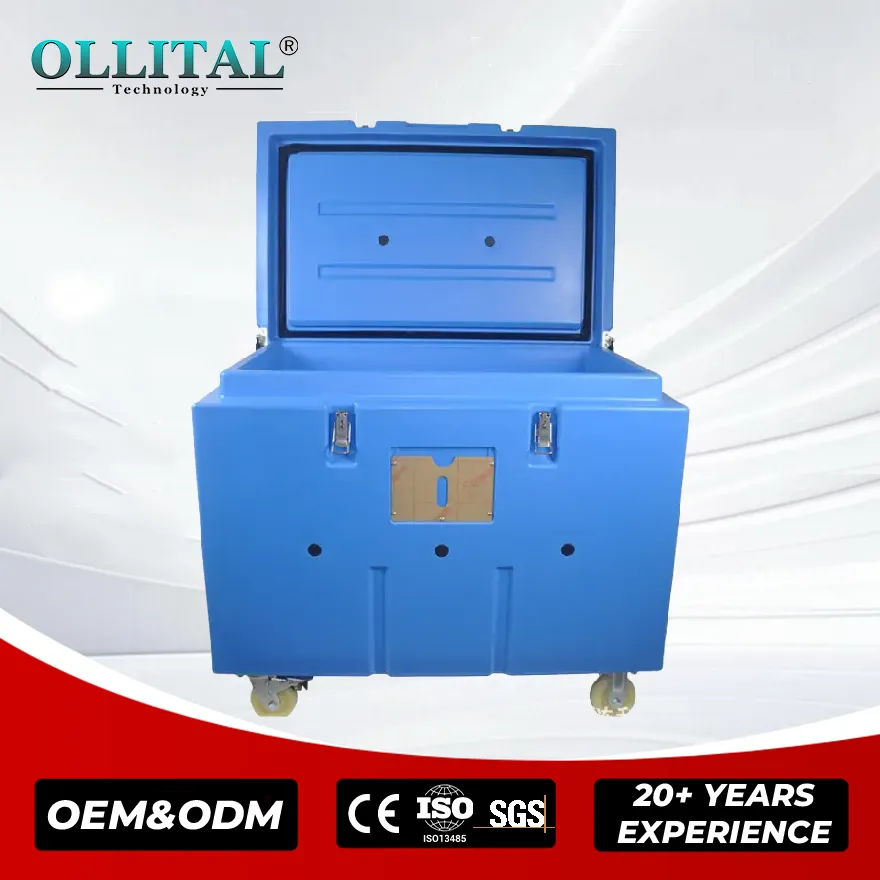
For example, a box rated using 3 mm granular dry ice cannot automatically be assumed to hold exactly the same mass or be equally easy to fill using longer, thicker pellets. Our 50 kg insulated dry ice storage box and 270 kg large-capacity box include published capacity references for 3 mm granular dry ice. Buyers planning to store 16 mm or 19 mm pellets should confirm practical filling mass, lid clearance and handling requirements using the chosen configuration.
Good insulation reduces heat transfer but does not stop sublimation. Never turn a dry ice box into a rigid airtight pressure vessel: CO₂ must be able to vent safely according to the container design, site requirements and transport rules. Appropriate ventilation, cold-protection gloves, eye protection and safe lifting practices remain essential.

Illustrative storage-and-portioning setup. Confirm usable loading volume, cold-safe handling and safe gas venting for the actual dry ice form and container.
5. Make the Size Decision With a Real Sample, Not a Catalog Photo
When an overseas buyer asks us for a dry ice pelletizer, our first response should be a few application questions, not an automatic recommendation based only on kg/h. We want to know whether the dry ice will be used for blasting, cooling, packaging or several tasks; which diameter the downstream equipment accepts; whether ice must be weighed automatically; and how long the product will be held before use.
A simple controlled sample trial often answers those questions quickly. Keep the incoming pellet mass comparable, record the sample diameter and length, use the same container and holding interval where appropriate, and compare usable ice at the point of use rather than only the initial appearance. For cooling, validate the temperature-control requirement of the real payload; for blasting, run a trial in the machine with the approved media specification; for packaging, observe consecutive packs at the intended line speed.
A Simple Decision Worksheet for Your RFQ
Decision question | What we ask buyers to provide |
|---|---|
Primary use | Blasting, bulk cooling, order packing, short buffer storage or more than one application |
Output requirement | Kilograms per hour, hours per shift, peak order quantity and future growth |
Pellet geometry | Required diameter; acceptable length variation; expected fines or breakage tolerance |
Interfaces | Blaster model/media size; infeed dimensions; weigher, bag or transfer requirements |
Storage and logistics | Holding time, box model, site conditions, pickup or dispatch frequency |
Acceptance method | Pilot sample, feed trial, usable quantity, appearance and repeatability checks |
If your facility needs multiple diameters, tell us whether they are required within one working day or in separate batches. That distinction affects die-change planning, cleaning and material segregation. A single producer may support several formats with the proper tooling, but simultaneous output or block production should never be assumed without a confirmed machine configuration.
Common Questions We Hear From Industrial Buyers
Can I use 16 mm or 19 mm pellets in a 3 mm dry ice blaster?
Not unless the exact blasting machine is specified and validated to accept that media size. Oversized ice can interfere with metering and delivery. For many systems, 3 mm is the starting point, but the blaster manual takes priority.
Does 19 mm dry ice always sublimate more slowly than 3 mm?
Do not rely on a universal percentage or guarantee based on diameter alone. Compare actual geometry, packing density, mass, storage interval, insulation, ventilation and handling. Measure the usable mass under the conditions that matter to your operation.
Can one pelletizer switch between 3 mm, 16 mm and 19 mm?
Some models offer alternative forming dies or customized tooling. Confirm which sizes are actually included, which changeover parts are required and whether the procedure is supported for the quoted machine. A model family description is not proof that every unit ships with every diameter.
Which pellet size is better for automatic dry ice packaging?
The best size is the one that your feeding, weighing, bag geometry and transfer system handle consistently. Conduct a sample packaging trial at the expected rate and check breakage, dose repeatability, seal contamination and downstream loading.
Is a larger pellet safer to handle?
Every dry ice size presents serious cold-contact and CO₂ accumulation risks. Select personal protective equipment and handling tools for the process; never handle dry ice with bare skin, use rigid airtight storage or ignore ventilation.
Do storage-box capacity ratings apply to every pellet diameter?
Not necessarily. The published storage mass may be based on a specified granular form. Verify actual loading, weight and clearance for the diameter you intend to use instead of copying a capacity value from another packing arrangement.
A More Useful Specification Starts With the Application
The real choice is not “3 mm versus 16 mm versus 19 mm” in isolation. It is a choice between complete workflows. 3 mm dry ice pellets are often the first format to evaluate for approved blasting systems. 16 mm and 19 mm pellets offer other handling and cooling possibilities where the downstream process has been checked. In every case, the material arriving at the end of the process matters more than a diameter label alone.
At OLLITAL, we recommend matching the production die, output target, transfer route, packaging plan and insulated storage method before the order is finalized. You can explore our dry ice production machine range to discuss suitable configurations, but the decision should start with your intended application and actual sample requirements.
Not sure which pellet diameter to specify? Send us your end-use process, target kilograms per hour, desired pellet size, storage time and downstream equipment details. We can review the application with you and identify the machine configuration and trial information needed before you commit to production equipment.
To discuss your project, visit OLLITAL Dry Ice Equipment and share your process details with our team.