





Quick Answer
A dry ice packaging line usually loses throughput because one station cannot consistently accept or release product at the rate of the rest of the line. The limiting point may be material feeding, weighing and metering, film movement, bag forming, sealing and cutting, finished-pack handling, or the transition into storage and dispatch. Increasing the nominal speed of the packaging machine does not solve a line that is starved upstream or blocked downstream. The practical objective is to find the station that creates the longest recurring wait, verify why it is happening under real dry ice conditions, and then balance the whole line around a sustainable rate rather than a brochure maximum.
Dry ice makes this especially important because the product is extremely cold, continuously sublimates, and can bring frost, condensation and handling constraints into a packaging process that might run very differently with room-temperature goods. A reliable solution therefore connects dry ice production, transfer, weighing, film and bag design, sealing, outfeed, insulated buffer storage and dispatch as one operating system.
1. A Packaging Bottleneck Is a Line-Balance Problem, Not Just a Machine-Speed Problem
When a packaging line falls behind target output, the first reaction is often to blame the main packaging machine. In practice, the packer may be stopping because it has no product to pack, because the weighing stage has not released a dose, because the film or bag path is unstable, or because completed packs have nowhere to go. The machine in the middle of the line may simply be where the symptom becomes visible.
A true packaging bottleneck is the station that limits sustained throughput over the operating period that matters to the business. It is not necessarily the slowest device on paper. A weighing system that pauses for a few seconds every cycle, a feeder that bridges intermittently, or a downstream table that fills every ten minutes can create a lower hourly output than a machine whose advertised speed looks much slower.
This is why line balance should be evaluated as a sequence of handoffs. Each stage must receive product, perform its task, and release product without repeatedly starving the next stage or backing up the previous one. For dry ice, the handoffs are particularly important because unnecessary residence time means more handling, more opportunity for sublimation loss, and more exposure to ambient heat and moisture.
2. Map the Line Before You Try to Fix It
Before changing settings, write down the actual flow from dry ice production to finished-pack dispatch. A common pellet-packaging arrangement is: upstream dry ice supply, short transfer or buffer, weighing or metering, film and bag forming, filling, sealing and cutting, coding or labeling when required, outfeed, insulated storage, and dispatch. Some projects combine several of these functions inside one machine; others use separate modules connected by conveyors.
OLLITAL's current OLT-360 horizontal automatic packaging machine is designed for integration with conveyors, weighing devices and other modules, while the current dry ice packaging line product adds automatic conveying, bagging, sealing, labeling and finished-product output as a larger system. The exact configuration should therefore be drawn as the customer will really run it, not as an isolated machine in a catalog.

A complete packaging line should be evaluated as a sequence of handoffs from dry ice supply to sealed packs and downstream storage or dispatch.
3. Bottleneck 1: Material Feeding and Conveying
Feeding problems are easy to overlook because the packaging machine can appear to run normally whenever product arrives. The hidden problem is the time between arrivals. If pellets reach the scale in bursts instead of a steady stream, the packer alternates between short periods of normal operation and repeated starvation. The average output falls even though no single stop looks serious.
Typical checks include the slope and geometry of chutes, conveyor speed, transfer height, accumulation points, product bridging, frost or ice buildup, and whether the upstream dry ice machine is producing at a rate that matches the packaging requirement. A transfer that works well with dry room-temperature granules may behave differently when it continuously receives very cold dry ice pellets.
Do not increase conveyor speed first and ask questions later. Faster transfer can create larger surges, more impact, more product movement and less control at the scale. The better target is stable feed. If the weighing device receives a predictable flow, it can usually release doses more consistently and the downstream packaging cycle becomes easier to balance.
A small intermediate buffer can help decouple production from packaging, but it should solve a real scheduling problem rather than become a place where dry ice waits unnecessarily. If the upstream production machine can be paced directly to the packaging line, short and controlled transfer is often preferable to building a large warm-area inventory.
4. Bottleneck 2: Weighing and Metering
The weighing stage frequently determines whether the rest of the line feels smooth or erratic. If the target dose is slow to stabilize, the packaging machine waits. If the dose overshoots repeatedly, operators may intervene, reject packs or reduce the feed rate. Either situation lowers sustained throughput.
Start by separating a weighing problem from a feeding problem. Watch whether the weigh hopper is waiting for product, receiving product too aggressively, or reaching the target weight and then delaying before discharge. Also check whether vibration from adjacent equipment, unstable product flow, sticking material or ice buildup is affecting repeatability. The scale should be assessed under the real pellet form and real pack weight the customer intends to sell or use.
Do not treat target weight as only a quality specification. It is also a timing variable. A line configured for larger packs may need a different feed pattern from a line making small bags. Likewise, multiple pack sizes can create changeover and control requirements that should be included when evaluating hourly output.
During commissioning, record the time required for several consecutive weigh-and-discharge cycles. The average matters, but the variation matters too. A line that produces ten fast cycles followed by one long unstable cycle may create more downstream disruption than a slightly slower but consistent weighing sequence.
5. Bottleneck 3: Film Tracking, Bag Forming and Package Dimensions
A dry ice packaging machine can only run smoothly if the selected film behaves correctly on the actual machine. Film that tracks poorly, wrinkles, slips, stretches unpredictably or does not seal consistently can force operators to reduce speed even when the mechanical line is capable of more.
The current OLT-360 product page highlights a linked film rolling shaft, touch-screen control, real-time packaging-temperature display and customizable bag and sealing options. These features support adjustment, but they do not eliminate the need to validate the real film. Film width, bag length, product height, roll diameter, tension and sealing response all influence whether the line can maintain stable operation.
Bag dimensions matter because overfilled or underfilled geometry changes the way product sits in the sealing zone. The right package is not simply the smallest film that can hold the nominal weight. It must leave enough space for filling, settling, controlled sealing, handling and whatever gas-release behavior is required by the final transport or storage method.
For dry ice, packaging design also has a safety dimension. Solid CO2 continuously releases gas as it sublimates. The package and shipping method must therefore be validated for the applicable transport rules, carrier requirements and operating conditions. Do not assume that the tightest possible seal is automatically the safest package for every dry ice application.

Film material, bag geometry and sealing style must be validated together under the real dry ice pack weight and operating condition.
6. Bottleneck 4: Sealing and Cutting
Sealing is often where a line is deliberately slowed to protect package quality. If the seal temperature, dwell, pressure, film tension or cut timing is unstable, speed increases can produce weak seals, wrinkled seals, product in the seal area or inconsistent bag lengths. The result is not higher output; it is more rework and more intervention.
Dry ice can make the sealing environment more demanding because the product is cold and local surfaces may experience frost or condensation depending on humidity and process layout. Keep the sealing zone as clean and controlled as practical. If pellets or debris enter the sealing area, the operator may see intermittent failures that look like a temperature problem even when the basic thermal setting is correct.
A useful troubleshooting method is to separate the variables. First confirm film tracking and bag formation. Then confirm the seal zone is clean. Next check the configured sealing temperature and timing against the selected film. Finally, observe several packs at the intended line rate rather than judging only one sample made at low speed.
Cutting is part of the same rhythm. Flat, serrated, rounded or other cutting styles may be selected according to the package requirement, but the cutting action has to remain synchronized with film movement and seal position. If the cut occasionally lands too close to the seal or creates film drag, the problem can propagate backward into the bag-forming stage.
7. Bottleneck 5: Finished-Pack Handling, Buffer Storage and Dispatch
A line can make perfect bags and still miss the production target because the finished packs cannot leave fast enough. Common downstream constraints include a short outfeed conveyor, insufficient accumulation space, manual boxing or palletizing that cannot keep pace, lack of insulated storage capacity, or a dispatch schedule that forces finished dry ice to wait in the wrong place.
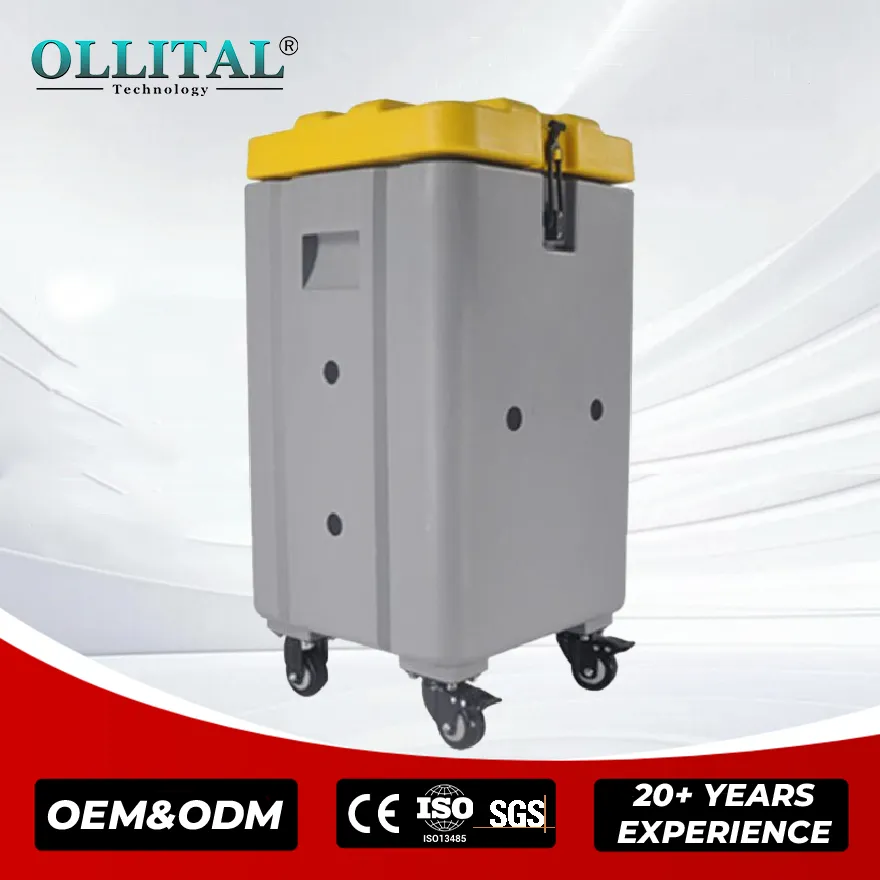
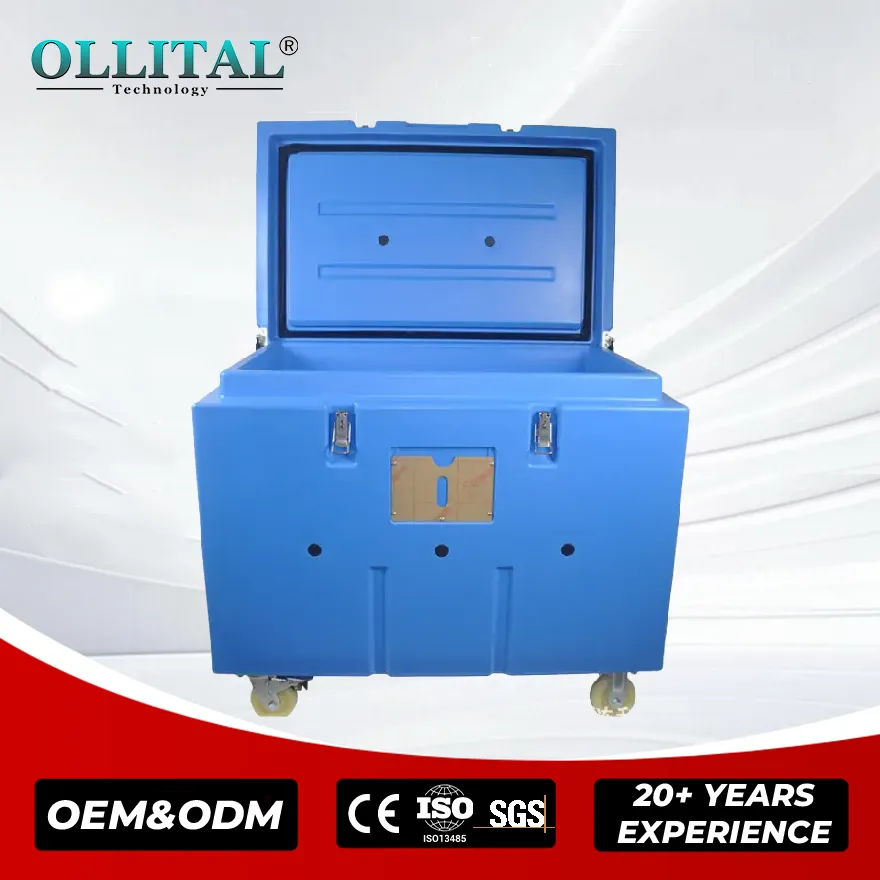
The key question is simple: where do sealed packs go next? If the answer is 'an operator picks them up when available,' then labor becomes part of line capacity. If the packs enter insulated storage, the number, size and location of the boxes become part of the packaging system. OLLITAL currently offers both a 50 kg dry ice storage box for compact handling and a 270 kg large-capacity box for higher-volume buffering.
Smaller boxes can support distributed handling and short movements between work areas. Larger boxes can reduce the number of container transfers when a central buffer is needed. Neither is automatically better. The correct choice depends on pack size, dispatch frequency, floor access, handling equipment and how long product should wait before shipment or use.
The best packaging line is therefore not the one with the fastest packer in isolation. It is the line that can move finished dry ice away from the sealing station at the same sustained rate the upstream system can produce it.
8. Catalogue Speed Is Not the Same as Sustained Throughput
Packaging equipment is often compared by a headline packs-per-minute figure. That number can be useful, but it is not a complete production forecast. Actual output depends on product form, pack size, film, sealing method, weighing method, line integration, changeovers, operator intervention, upstream supply and downstream handling.
The current OLT packaging family supports multiple machine sizes and configurations, including different film widths, bag dimensions, sealing patterns and optional functions. That flexibility is useful precisely because one speed figure cannot represent every application. A small pellet pack running on a stable film may operate very differently from a larger package, block product or custom film structure.
For purchasing decisions, ask for the conditions behind any speed figure: product form, target pack weight, film, bag dimensions, whether weighing is included, whether coding or labeling is included, and whether the quoted speed is a short machine cycle or a sustained integrated-line result. This turns a vague capacity conversation into an engineering discussion.
9. A Practical Way to Measure the Real Bottleneck
You do not need a complex software project to identify the first major constraint. Start with a timed observation under normal production. Record what the packaging machine is doing whenever it is not making a good pack. Classify the lost time instead of writing only 'machine stopped.'
| Observed State | What It Usually Means | First Area to Check |
|---|---|---|
| Starved | No dry ice available at the packer | Check upstream production, transfer and weighing release. |
| Waiting for weight | Dose not ready or unstable | Check feed pattern, weigh stability, target weight and discharge timing. |
| Film / bag stop | Film mis-tracking, wrinkle or bag-form issue | Check roll setup, tension, dimensions and forming path. |
| Seal / cut stop | Seal quality or cut timing requires correction | Check cleanliness, film response, temperature, timing and synchronization. |
| Blocked | Finished packs cannot leave the machine | Check outfeed, accumulation, operator handling, storage and dispatch. |
| Changeover | Format or film change takes excessive time | Standardize settings, tools, material staging and verification steps. |
After one observation period, total the lost time by category. The largest repeatable category is usually a better starting point than whichever stop looked most dramatic. Make one controlled change, run again, and see whether the constraint moved to another station. Bottleneck work is iterative because improving one step often reveals the next limitation.
10. Balance Packaging with Dry Ice Production Upstream
A packaging line cannot be stable if upstream dry ice production is treated as an unrelated process. If the production machine delivers large batches followed by long gaps, the packaging system either needs a controlled buffer or it will alternate between overload and starvation. If production is slower than packaging, increasing packaging speed creates no additional finished output.
Start with the real production schedule. Determine the expected kilograms of dry ice per hour, the intended pack weight, the number of packs per hour, and the acceptable buffer between production and packaging. Then select the transfer and weighing arrangement that can supply the packer at that rhythm. OLLITAL's dry ice production machine range covers multiple capacities, so the packaging system should be matched to the selected production equipment rather than sized independently.
For facilities producing only during short windows, a packaging line may need to absorb a higher short-term rate than the daily average. For continuous production, consistency and uptime may matter more than short peak speed. These are different design problems and should be tested differently.
11. Balance Packaging with Storage and Dispatch Downstream
The downstream side should be designed from the dispatch plan backward. Define how many packs leave the line in a typical hour, where they are staged, how often storage boxes are opened, who moves them, and when the shipment leaves. If finished packs accumulate on the conveyor while an operator searches for space, the packaging line is already being controlled by logistics rather than by the packaging machine.
For lower-volume or distributed use, multiple 50 kg boxes can keep smaller quantities close to points of use. For central staging or higher-volume dispatch, 270 kg boxes can provide a larger buffer with fewer container transfers. A mixed strategy is also possible when central reserve and local issue points are both needed.
The important principle is to create enough downstream capacity to absorb normal variation without encouraging unnecessary long storage. Dry ice will continue to sublimate, so the goal is not to maximize inventory. The goal is to keep the packaging machine from being blocked while product moves efficiently toward use or dispatch.

Packaging equipment selection should include upstream supply, line rate, utilities, bag format, sealing method and downstream storage/dispatch rather than only the central machine.
12. What to Validate During a Real Packaging Trial
• Dry ice form and actual pack weight, not a substitute room-temperature product.
• Real film structure and roll width, including film tracking at the intended operating speed.
• Actual bag width, length and product height after filling and settling.
• Weighing repeatability and the time required for consecutive doses.
• Seal appearance and consistency after multiple cycles, not only one sample.
• Cut position, bag separation and finished-pack transfer to the outfeed.
• Upstream feeding stability and whether the packer is repeatedly starved.
• Downstream accumulation and whether finished packs block the machine.
• Operator access for roll changes, cleaning, inspection and normal adjustment.
• Safe package/venting behavior for the intended storage and transport method, verified against the applicable local and carrier requirements.
A useful trial does not need to prove that the machine can run at the highest possible speed for one minute. It should show that the complete configured line can produce acceptable packs repeatedly, recover from normal small disturbances, and transfer finished product without creating a new bottleneck.
13. Where the OLT-360 Fits
The OLLITAL OLT-360 horizontal automatic packaging machine is relevant when a project needs configurable film, bag dimensions, sealing and cutting options, touch-screen control and integration with weighing or conveying modules. The current product information also lists an air-source requirement and customizable electrical and packaging configurations, so utilities should be confirmed as part of the line design.
The OLT-360 should not be selected only because it appears to have sufficient nominal speed. The pack format, dry ice form, feeding method, weighing device, film behavior, downstream storage and required changeovers all affect the final result. For higher levels of automation, OLLITAL also lists a dry ice packaging line with conveying, bagging, sealing, labeling and finished-product output integrated into the process.
The right question is therefore not 'How fast is the packaging machine?' but 'What sustained output can the complete configured line achieve with my product, film, pack size, upstream supply and dispatch method?'
Useful OLLITAL Equipment Pages for Line Planning
OLT-360 Horizontal Automatic Dry Ice Packaging Machine — Review film, bag, sealing, control and integration options for the horizontal packaging platform.
Dry Ice Packaging Line / Vacuum Packaging Machine — Review the larger automated line concept with conveying, bagging, sealing, labeling and finished-product output.
Dry Ice Production Machines — Match upstream dry ice output to the packaging rate and production schedule.
50 kg Dry Ice Storage Box — Consider compact downstream buffer storage and distributed handling.
270 kg Large-Capacity Dry Ice Storage Box — Consider larger central buffer storage for higher-volume staging and dispatch.
FAQ
Q: Why does my packaging machine stop even though its rated speed is high?
A: Because the central machine may be waiting for product, waiting for a weight, correcting film or seal conditions, or blocked by finished packs. Rated machine speed does not include every upstream and downstream delay in a real integrated line.
Q: Should I increase conveyor speed when the packer is being starved?
A: Not automatically. First determine why the feed is unstable. A faster conveyor can create larger surges and make weighing less consistent. Stable material flow is usually more useful than maximum transfer speed.
Q: Can the weighing system become the main bottleneck?
A: Yes. If each dose takes too long to stabilize or discharge, the packaging machine waits. Evaluate the real pack weight, feed behavior, vibration, product condition and cycle-to-cycle variation.
Q: Why can seal quality get worse when packaging speed is increased?
A: Higher speed changes the time available for film movement, sealing and cutting. If film tracking, seal cleanliness, temperature or timing is already marginal, increasing speed can expose the weakness quickly.
Q: Should dry ice bags be sealed as tightly as possible?
A: Do not use that as a universal rule. Dry ice releases CO2 gas as it sublimates. Package design must be validated for the intended storage and transport method and must comply with applicable local and carrier requirements for gas release, marking and handling.
Q: How much buffer storage should be placed after the packaging machine?
A: Enough to prevent normal downstream variation from blocking the line, but not so much that product waits unnecessarily. The correct buffer depends on line rate, dispatch interval, box size, handling method and the time between packaging and use or shipment.
Q: What data should I send OLLITAL for a packaging-line recommendation?
A: Provide dry ice form, target pack weight, desired bags per hour or kilograms per hour, film type if known, bag dimensions, upstream production capacity, available utilities, downstream storage method and any coding, labeling or automation requirements.
Conclusion
A productive dry ice packaging line is built by balancing every handoff, not by maximizing one machine in isolation. Feeding has to be steady, weighing has to be repeatable, film has to track correctly, seals and cuts have to remain stable, and finished packs must leave the machine without creating a downstream queue.
The most useful troubleshooting question is therefore: where is the line waiting, and why? Once lost time is classified by station, the team can make targeted changes and verify whether sustained throughput improves. This approach usually produces better results than repeatedly increasing speed settings without understanding the constraint.
For a new project, validate the complete system with the real dry ice form, pack weight, film, bag size, production rate and storage/dispatch method before finalizing the configuration. That is the point where line performance becomes a practical production result rather than a catalog estimate.
Contact OLLITAL to review your dry ice form, target pack size, packaging rate, film, upstream production capacity and downstream storage plan.
Need help identifying the real bottleneck before you specify the line?
Send your intended dry ice form, package dimensions, target output and current process flow. OLLITAL can help you compare a practical packaging-machine configuration and the upstream/downstream modules needed around it.