





Introduction
Industrial maintenance faces a perpetual challenge: balancing thorough cleaning with minimal downtime and environmental impact. Traditional methods—such as pressure washing, chemical solvents, or abrasive blasting—often require extensive preparation, can damage sensitive equipment, and generate secondary waste that must be disposed of safely. In contrast, dry ice cleaning offers a non-abrasive, residue-free solution that preserves surface integrity, reduces maintenance cycles, and aligns with increasingly strict environmental regulations.
Originally developed in the 1970s for the aerospace industry, dry ice cleaning has evolved into a versatile technology serving sectors like automotive manufacturing, food processing, printing, power generation, and more. As production lines become more complex and uptime becomes more critical, industrial buyers are actively seeking efficient cleaning methods that ensure equipment longevity and product quality.
This guide delves into every aspect of dry ice cleaning machines—from fundamental principles and operational mechanics to practical considerations for selecting the right model. Whether you’re an operations manager, maintenance supervisor, or procurement specialist, you’ll gain actionable insights tailored to North American and European B2B markets.
What Is a Dry Ice Cleaning Machine?
A dry ice cleaning machine, also known as a dry ice blaster or dry ice blasting machine, uses solid carbon dioxide (CO₂) pellets, commonly referred to as dry ice, as the cleaning medium. Unlike wet blasting techniques that rely on water or air alone, dry ice cleaning propels frozen CO₂ particles at high velocity onto the target surface. Upon impact, the dry ice pellets sublimate instantly—from a solid to a gas—removing contaminants without generating secondary waste.
Key Components of a Dry Ice Cleaning System:
Dry Ice Pellet Hopper: Stores the dry ice pellets, which are fed into the blasting unit. Pellet sizes range from 1/8″ to 1/4″ in diameter depending on the machine and application.
Blasting Gun and Nozzle: Engineered for precise control and durability. Nozzle sizes and shapes (e.g., straight bore vs. venturi) influence the spread and intensity of the pellet stream.
Air Compressor Connection: Provides high-pressure air (typically between 80–150 psi) required to accelerate the dry ice. Compressor capacity (PSI/CFM) must match machine specifications.
Control Valves and Regulators: Enable adjustment of air pressure and pellet feed rate, allowing operators to tailor the intensity based on surface sensitivity and contaminant type.
Exhaust System/Extraction Hood (Optional): Captures and vents the gaseous CO₂ and dislodged particles, ensuring a safe work environment in enclosed spaces.
Operating Principle: The process leverages three synergistic effects:
Kinetic Energy Impact: High-speed dry ice pellets strike the surface, dislodging contaminants such as grease, oil, paint, or carbon.
Thermal Shock: At -78.5°C (-109.3°F), dry ice causes rapid cooling of the contaminant layer, making it brittle and easier to fracture.
Sublimation Effect: As pellets turn directly into gas upon impact, they expand nearly 800-fold in volume, lifting contaminants away from the substrate and leaving no residue.
By combining these effects, dry ice cleaning achieves thorough, non-destructive cleaning suitable for delicate substrates—such as electrical components, precision mold surfaces, or delicate conveyor belts—that would be damaged by traditional abrasive or wet methods.
How It Works: Step-by-Step Technical Overview
Understanding the operational nuances of dry ice cleaning machines is crucial for selecting the ideal model and optimizing cleaning processes. Below, we break down each phase and highlight key technical parameters:
Dry Ice Pellet Preparation and Loading
Pellet Manufacturing: Dry ice pellets are typically produced via a dry ice maker or purchased from a supplier. Pellets come in various shapes—cylindrical, triangular, or block form.
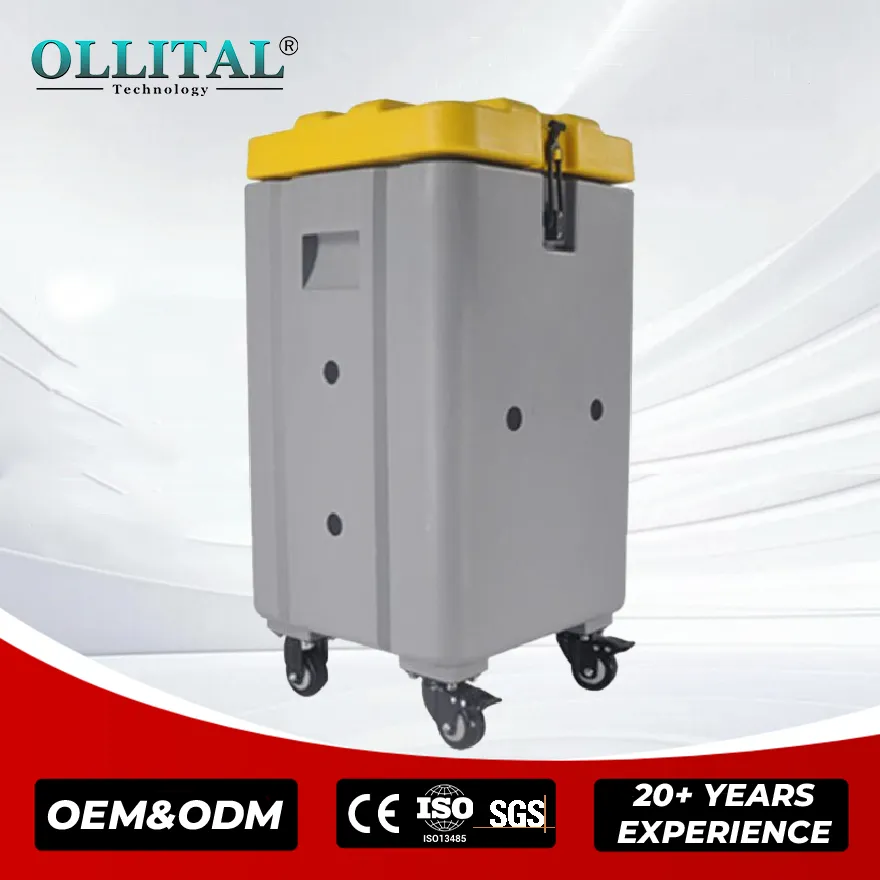
Storage: To minimize sublimation loss, pellets are stored in insulated containers at temperatures below -20°C (-4°F). The hopper on the cleaning machine should maintain similar conditions to prevent premature sublimation.
Loading: Operators fill the machine’s designated hopper, ensuring pellet sizes match the equipment’s feed mechanism. Some systems require manual stirring to prevent bridging.
Compressed Air Supply and Regulation
Air Compressor Requirements: Most dry ice cleaning machines operate optimally between 80–150 psi and require airflow between 10–50 CFM (cubic feet per minute), depending on the model size (light, medium, or heavy-duty).
Regulation: A high-quality regulator and air filter system ensure consistent pressure and remove moisture or oil contaminants from the compressed air, which could cause blockages or reduce cleaning efficiency.
Pellet Acceleration and Nozzle Dispersion
Venturi vs. Straight Nozzle: Venturi nozzles use a compressed air-induced vacuum to draw dry ice into the airstream, allowing for a more concentrated blast. Straight nozzles mix pellets and air directly but can consume pellets at a slower rate.
Nozzle Selection: Nozzles vary in diameter (e.g., 3/8″ to 1/2″) and length. Narrower nozzles concentrate the blast for precision cleaning, while wider nozzles cover larger surface areas for faster bulk cleaning.
Surface Impact and Sublimation Dynamics
Kinetic Effect: Pellets traveling at speeds up to 246 m/s (550 mph) strike contaminants, fracturing them.
Thermal Cycling: Rapid cooling induces a thermal shock, causing cracks to form between the contaminant and substrate.
Sublimation Pressure: Once the pellet contacts the surface, it sublimates. The resulting CO₂ gas expands roughly 800 times, effectively lifting fragmented contaminants away.
Debris Ejection: Contaminants are dislodged and typically fall away; a vacuum or exhaust hood captures larger particles if needed (often in food or pharmaceutical environments where cleanliness is critical).
Operator Controls and Safety Interlocks
Adjustable Feed Rate: Controls pellet flow to fine-tune cleaning intensity. Lower feed rates (15–25 lbs/hr) suit delicate tasks, while higher rates (50–100 lbs/hr) address heavy-duty industrial grime.
Pressure Gauges and Emergency Shutoff: Ensure operators can instantly cut off steam in case of nozzle blockage or unsafe conditions.
Protective Gear: Operators typically wear face shields, insulated gloves, and hearing protection, as the process can produce noise levels up to 90–100 dB.
By mastering these operational details, industrial buyers can optimize cleaning protocols, reduce material consumption, and ensure consistent performance across diverse applications.
|
|


Key Advantages of Dry Ice Cleaning Machines
Investing in dry ice cleaning technology delivers multiple strategic benefits for industrial operations. Here’s an in-depth look at each advantage, backed by real-world examples and data insights:
Non-Abrasive Cleaning
Surface Preservation: Unlike sandblasting, which abrades surface microscopically, dry ice cleaning preserves the underlying substrate. For instance, injection mold manufacturers report up to 80% reduction in mold wear and tear compared to metal grit blasting (Source: PlasticIndustryMag, 2023).
Sensitive Components: In electronics manufacturing, dry ice cleaning safely removes flux residues and conformal coatings from printed circuit boards without damaging traces or solder joints.
Dry, Residue-Free Process
No Secondary Waste: Since CO₂ sublimates completely, operators aren’t left managing spent media or contaminated water run-off. Food processors often choose dry ice cleaning to sanitize ovens and freezers, because there’s no moisture that could promote microbial growth (Source: FoodSafetyOnline, 2024).
Reduced Cleanup Time: Post-cleaning residuals are minimal—operators typically use a brush or vacuum to remove debris.
Environmentally Friendly and OSHA Compliant
Recycled CO₂ Source: Many dry ice pellets are manufactured from reclaimed CO₂ generated as a byproduct from industrial processes, making this a sustainable choice. It also doesn’t introduce volatile organic compounds (VOCs) into the environment, aligning with EPA regulations.
Employee Safety: CO₂ is non-flammable and non-toxic at typical operational concentrations. Proper ventilation ensures workplace CO₂ concentrations remain below OSHA’s Permissible Exposure Limit (PEL) of 5,000 ppm over an 8-hour TWA.
Minimal Downtime and Disassembly
In-Situ Cleaning: Many industrial assets—like large mold assemblies or production lines—can be cleaned without dismantling. A food processing plant reported reducing cleaning downtime by 50% after switching from pressure washer methods (Source: PlantMaintenanceTech, 2022).
Quick Changeovers: Cleaning cycles often take 5–20 minutes per part, whereas manual scrubbing can take upwards of an hour per component.
Cost-Effectiveness Over Time
Labor Savings: Operators spend significantly less time on manual scrubbing; labor cost savings range from 30%–60% per cleaning cycle in automotive plants (Source: AutoManuJournal, 2023).
Extended Equipment Life: By preventing abrasive wear, molds and machinery last longer, reducing capital expenditure for replacements. Some companies report a 20% extension in mold lifetime.
Versatility Across Contaminants and Surfaces
Grease, Oil, Carbon, and Coatings: From industrial ovens to paint shops, dry ice effectively tackles heavy carbon deposits and paint overspray without chemical solvents.
Biofilm and Microbial Residues: In pharmaceutical and healthcare settings, dry ice cleaning is used to remove biofilms from stainless steel surfaces, meeting stringent GMP (Good Manufacturing Practice) standards.
Applications Across Industries: In-Depth Use Cases
Dry ice cleaning’s versatility makes it valuable across a spectrum of industries. Below, find detailed examples and case studies illustrating successful applications.
1. Automotive Manufacturing
Engine Block Cleaning: Automotive OEMs use dry ice cleaning during engine remanufacturing to strip carbon deposits from cylinder heads. A major North American remanufacturer reported reclaiming 95% of cylinder heads that were previously scrapped due to excessive manual cleaning time.
Paint Booth Maintenance: Paint overspray accumulates on booth walls, conveyor rails, and fixtures. Dry ice cleaning removes paint buildup without shutting down the booth for extended periods, boosting paint line uptime by 20%.
2. Plastic Injection Molding
Mold Release Residue Removal: Injection molds accumulate plastic residues and release agents that affect product quality. A European plastic parts manufacturer achieved a 40% reduction in cycle times after adopting dry ice cleaning, as mold surfaces remained cleaner for longer.
Tooling Preservation: Traditional scrapers can scratch mold cavities; dry ice cleaning ensures cavity surfaces remain mirror-smooth, reducing flash defects and scrap rates by up to 15%.
3. Food & Beverage Processing
Oven and Freezer Decontamination: Bakeries and meat processing plants use dry ice to remove baked-on residues and biofilms from tunnels and freezers during routine shutdowns. Without water, equipment is immediately ready for use, avoiding rework or bacterial growth issues.
Filling Machine Sanitation: Dry ice cleans gaskets, pumps, and nozzles without disassembling the entire filling line, saving dozens of labor hours per month.
4. Printing & Packaging
Ink and Adhesive Removal: Graphic printing labs rely on dry ice blasting to clean ink tanks, rollers, and spreaders. A packaging company reported a 30% increase in print quality consistency after switching from manual cleaning methods.
Die Cutter Cleanup: Corrugated box manufacturers use dry ice to clear adhesive buildup in die-cutting presses, ensuring precise cuts and reducing downtime.
5. Power Generation & Energy Sector
Turbine Blade Maintenance: Gas turbine operators use dry ice to remove carbon residues from blades without shutting down turbines for extended periods. This practice has been linked to a 10% improvement in turbine efficiency and a 15% reduction in unplanned outages.
Generator Stator Cleaning: Utility providers employ dry ice to clean stator windings and bus bars, reducing risk of electrical faults caused by grime or resin deposits.
6. Aerospace & Defense
Composite Component Preparation: Aircraft manufacturers clean composite molds and parts before bonding, ensuring optimal adhesion without chemical solvents that could degrade composites.
Tooling and Fixture Maintenance: Dry ice cleaning preserves the dimensional accuracy of mission-critical jigs and fixtures, preventing costly rework.
Choosing the Right Dry Ice Cleaning Machine: Detailed Selection Criteria
Selecting an appropriate dry ice cleaning machine involves evaluating multiple factors to match your unique operational needs. Below are in-depth considerations to ensure optimal performance and ROI.
1. Cleaning Intensity and Output Capacity
Light-Duty vs. Heavy-Duty Models: Light-duty machines (20–30 lbs/hr) suit precise tasks—e.g., electrical panel maintenance or small component cleaning—whereas heavy-duty units (80–150 lbs/hr) address large industrial equipment requiring rapid bulk cleaning.
Nozzle Versatility: Some systems offer interchangeable nozzles for both precision and high-coverage cleaning. Ensure your supplier provides a range of nozzles to adapt to various tasks.
2. Air Consumption and Compressor Requirements
PSI (Pounds per Square Inch): Machines may require operating pressures from 80 psi for delicate work to 150 psi for intensive cleaning. Confirm that your facility’s compressor can sustain necessary pressures consistently.
CFM (Cubic Feet per Minute): Heavy-duty units may demand 40–60 CFM, impacting compressor sizing. Under-sizing leads to reduced blasting force, lowered efficacy, and increased cleaning time.
3. Hopper Capacity and Automatic Feed Systems
Manual Feed vs. Automatic Auger: Manual feed hoppers require operators to replenish dry ice frequently, which can disrupt workflow. Automatic auger systems maintain consistent pellet feed, ideal for continuous operations.
Insulation and Storage Lifespan: Hoppers insulated with vacuum panels or specialized foam reduce pellet sublimation, decreasing operational waste.
4. Mobility and Ergonomics
Portable vs. Stationary Units: Portable systems mounted on casters or trailers enable on-site service calls—critical for field maintenance in remote locations. Stationary units may offer higher capacities and advanced features but lack portability.
Ergonomic Gun Design: Lightweight guns with adjustable handles and insulated grips reduce operator fatigue during extended cleaning sessions.
5. Safety Features and Compliance
CO₂ Monitoring and Ventilation: Machines with integrated CO₂ sensors and alarms help maintain safe operating environments, particularly in confined spaces.
Noise Levels: Look for models with noise-reduction features (enclosed blasting chambers or muffler systems) if operators work in populated areas. OSHA recommends hearing protection for exposure above 85 dB.
Certifications: Ensure equipment meets CE (for Europe), UL (for North America), and other relevant industrial safety standards.
6. Maintenance and Service Support
Ease of Service: Choose machines with accessible components—filters, regulators, and hoses—for quick replacement and minimal downtime.
Spare Parts Availability: Work with suppliers who maintain local inventories of wear parts (nozzles, seals, hoses) to reduce lead times.
Technical Training and Documentation: Comprehensive user manuals, training videos, and on-site support help your maintenance team get up to speed quickly.
7. Customization and Scalability
Modular Add-Ons: Some manufacturers provide modular options—such as robotic integration kits or multi-gun setups—to streamline future expansions.
Scalable Pricing Models: Evaluate suppliers offering leasing, rental, or subscription-based dry ice supply models to manage upfront costs effectively.
By carefully assessing these criteria and collaborating with trusted vendors—like OLLITAL, which specializes in custom solutions—you can tailor a dry ice cleaning setup that maximizes productivity and minimizes total cost of ownership.
Cost and ROI Considerations: Quantitative Analysis
Investing in dry ice cleaning technology involves a thorough financial evaluation. Below is a step-by-step breakdown—complete with sample calculations—to illustrate total cost of ownership (TCO) and return on investment (ROI).
1. Initial Capital Expenditure (CAPEX)
Machine Purchase Price: Light-duty models range between $4,600–$6,700; medium-duty units range $7,000–$12,000; heavy-duty systems can exceed $15,000 (Source: IndustryPricingReport, Q1 2025).
Auxiliary Equipment: High-capacity air compressors ($4,000–$5,000), CO₂ storage bins ($2,500–$6,000), and safety gear (PPE packs at $200–$500 per operator).
Total CAPEX Example (Medium-Duty Setup):
2. Operational Expenditure (OPEX)
Dry Ice Consumables: Pellet cost averages $0.80–$1.20 per lb depending on volume discounts. A medium-duty machine consuming 50 lbs/hr at $1.00/lb results in $50/hr in consumables.
Compressed Air Energy Cost: Running a 100 CFM compressor at 100 psi for 8 hours/day can consume approximately 40 kWh, costing around $5–$8 per day (varies by local electricity rates).
Labor Costs: Assuming an operator wage of $25/hr, a cleaning cycle of 2 hours (including set-up and tear-down) costs $50 in labor. Traditional hand-cleaning may require 5 hours at $125 in labor.
Maintenance Costs: Annual preventative maintenance (filters, seals, nozzles) can average $1,500–$3,000 depending on usage frequency.
Total OPEX Example (Annual, 250 Operating Days):
3. Comparative Cost Savings
Direct comparison with traditional cleaning methods (e.g., manual scrubbing, chemical wash) reveals:
Labor Hours Saved: Traditional cleaning requiring 5 hrs/cycle vs. 2 hrs with dry ice results in a 60% labor reduction. If traditional labor cost is $125/cycle vs. $50/cycle with dry ice, annual saving is $18,750 (250 cycles).
Reduced Production Downtime: If traditional cleaning causes 8 hrs of downtime vs. 3 hrs with dry ice, and production line value is $1,000/hr, daily saving is $5,000. On 50 critical cleaning events/year, saving is $250,000.
Equipment Longevity: Conservatively, extending mold life by 20% reduces annual capital replacement costs by $10,000–$20,000 for high-value tooling.
4. ROI Calculation Example
Frequently Asked Questions (FAQs)
1. Is dry ice cleaning safe for all surfaces?
Yes, provided the correct pressure and nozzle configuration. Delicate substrates (e.g., thin-walled plastic parts, sensitive electronics) require lower pressures (80–90 psi) and smaller nozzles (3/8″ diameter). Always conduct a test spot before full-scale cleaning.
2. Does it leave any residue or moisture behind?
No. Dry ice sublimates directly into CO₂ gas, so there’s no liquid or secondary waste. Operators typically sweep or vacuum away dislodged contaminants.
3. Can dry ice cleaning replace chemical solvents completely?
In many cases, yes. Chemical solvents often leave behind toxic byproducts and require extensive rinsing. Dry ice cleaning offers a greener alternative, eliminating the need for hazardous chemicals and water treatment.
4. Is it safe for food processing and pharmaceutical environments?
Absolutely. Since it’s non-toxic and leaves no residue, it meets FDA, USDA, and GMP standards. Many food plants use it during scheduled shutdowns to sanitize ovens, conveyors, and mixing tanks without introducing moisture that could promote bacterial growth.
5. How much dry ice does the machine consume per hour?
Consumption rates vary by model and application intensity. Light-duty machines may use 15–25 lbs/hr for detailed component cleaning. Medium-duty units might consume 50–75 lbs/hr, while heavy-duty systems can exceed 100 lbs/hr. Precise consumption depends on nozzle size, pressure setting, and contaminant thickness.
6. What are common maintenance tasks for a dry ice cleaning machine?
Nozzle Inspection and Replacement: Nozzles wear out over time (especially straight bore nozzles), typically requiring replacement every 500–1,000 operating hours.
Filter and Regulator Maintenance: Regularly change air compressor filters to prevent moisture and oil carryover; inspect regulators for consistent pressure output.
Hopper Cleaning: Remove any residual dry ice particles after each use to prevent bridging or ice blockages.
Cold Flow Valve Check: Verify that the cold flow valve (which controls pellet feed) operates smoothly to ensure a consistent pellet stream.
7. What safety precautions should operators follow?
Use insulated gloves and safety goggles to protect from frostbite and flying debris.
Ensure proper ventilation; CO₂ concentration should remain below OSHA’s 5,000 ppm PEL.
Wear hearing protection if noise exceeds 85 dB.
Maintain a safe distance (typically 6″–12″) between nozzle and surface to optimize cleaning effectiveness.
8. Can a dry ice cleaning machine be integrated into automated systems?
Yes, many manufacturers offer robotic integration kits with programmable gantries, allowing for automated cleaning of complex parts. This is particularly useful in high-volume automotive and aerospace production lines.
Conclusion
Dry ice cleaning machines represent a paradigm shift in industrial maintenance—combining non-abrasive cleaning, environmental stewardship, and rapid turnaround. From automotive plants seeking to slash engine rebuild times to food processors requiring residue-free sanitation, the applications are broad and impactful.
By understanding operational principles, evaluating key selection criteria, and analyzing cost and ROI, industrial buyers can make data-driven decisions that lead to significant productivity gains and long-term savings. Whether you’re upgrading existing cleaning processes or building a new maintenance strategy, partnering with a reliable supplier—such as OLLITAL, with customizable solutions tailored to your facility—ensures you harness the full potential of dry ice cleaning technology.
Ready to take the next step? Contact our specialists today for a personalized consultation and see how dry ice cleaning can revolutionize your operations.