







Introduction
Dry ice blasting can be a valuable maintenance method for selected electrical equipment when the work is planned correctly, the system is fully de-energized, and the cleaning goal is clearly defined. Unlike water-based washing or media that leave residue behind, dry ice blasting offers a dry process that can remove dust, carbonized deposits, light oil contamination and process residue without introducing secondary blasting media into cabinets, windings or fine control assemblies.
That does not mean every electrical asset should be cleaned the same way. Switchgear, PLC cabinets, motor stators, generator windings and precision control electronics all have different contamination patterns, access limitations, insulation concerns and acceptance criteria. Buyers evaluating this process are usually not just asking whether dry ice blasting works; they want to know where it fits, what precautions are required, what the cleaning limits are and how to choose equipment that gives precise control rather than aggressive bulk cleaning.
This guide explains how dry ice blasting fits electrical equipment maintenance and where the OLLITAL P60 fine-work configuration is most useful. The focus is on practical industrial use: de-energized switchgear and control cabinets, electric motors and generator components, and precision electronics or PCB-related assemblies that need controlled, residue-free cleaning support.
1. Why Electrical Equipment Maintenance Needs a Dry, Controlled Cleaning Method
Electrical equipment is often damaged less by a single dramatic event than by gradual contamination. In industrial plants, electrical rooms and production lines, contamination may include conductive dust, carbon fines, oily residue, packaging dust, paper fibers, process debris and airborne contamination drawn into cooling paths. Over time this buildup can reduce heat dissipation, interfere with airflow, create tracking risks, block contact surfaces or make inspection more difficult.
Traditional cleaning choices each have tradeoffs. Manual wiping is slow and inconsistent in confined spaces. Compressed air can simply redistribute contamination deeper into the cabinet or surrounding area. Wet washing introduces drying requirements and may be unacceptable for sensitive components or tight restart windows. Abrasive media can be too aggressive for surfaces, insulation systems or fine assemblies. Dry ice blasting becomes attractive when maintenance teams need a dry process, no secondary blasting media and better access into narrow areas than manual cleaning allows.
For electrical applications, however, process control matters more than raw blasting power. The machine, hose, nozzle, operator technique and stand-off distance all influence whether the process remains precise and maintenance-friendly. That is why fine-work applications require a compact unit with controllable output rather than a one-size-fits-all heavy blasting setup.
2. Switchgear and Control Cabinet Cleaning
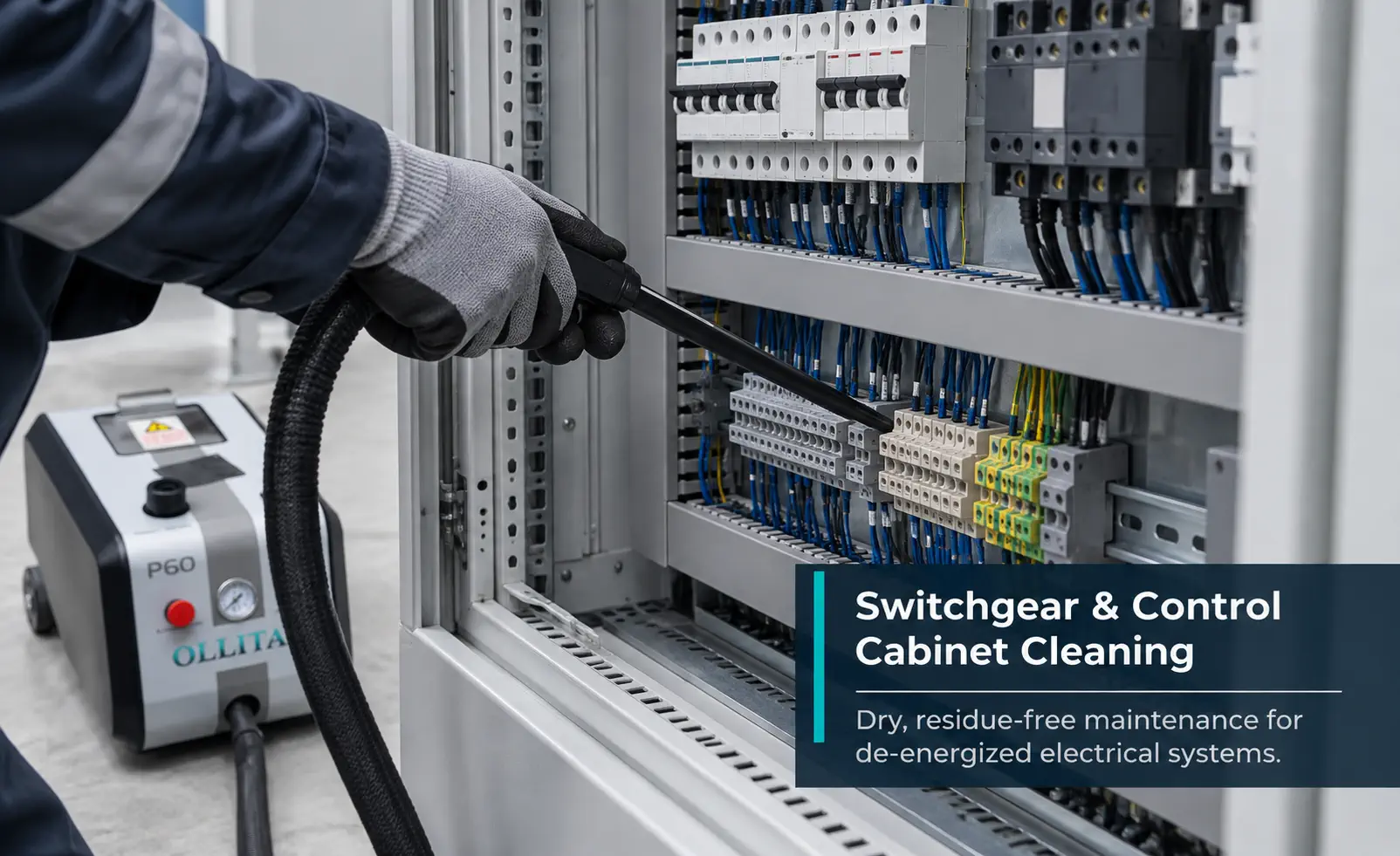
Switchgear and control cabinet cleaning — dry, residue-free maintenance for de-energized electrical systems.
Switchgear and control cabinets are among the most immediately understandable use cases for dry ice blasting, but they also require disciplined procedures. Typical contamination includes dust accumulation around terminal blocks, light film on panel interiors, residue near contactors and relays, and general buildup around cable ducts, ventilation paths and lower cabinet areas. In plants with packaging, wood processing, converting, food packaging or dusty process environments, contamination can build quickly and make preventive maintenance harder.
The main advantage of dry ice blasting in these cabinets is that the process is dry and leaves no additional blasting media behind. That is especially helpful in spaces with many wires, terminals and layered components where secondary cleanup would be costly. A controlled nozzle can also reach recesses that are difficult to wipe by hand. For maintenance teams, this can shorten cleaning time while improving visibility for inspection and troubleshooting.
That said, the correct target is usually a fully de-energized cabinet prepared for maintenance, not a live panel. The process should be planned after lockout-tagout, verification of zero energy and confirmation that the component mix is suitable for the selected method. Output settings should remain conservative, with attention to nozzle distance and blast angle to avoid unnecessary stress on labels, fragile clips, loose wiring or poorly retained small parts.
In practical terms, dry ice blasting in switchgear and control cabinets is best used for housekeeping-level contamination, light residue removal and maintenance preparation. It helps expose terminal identification, improve cleanliness around cable management and support visual inspection. It should not be marketed as a universal remedy for damaged contact surfaces, burnt internals or electrically failed components.
3. Motor Stator and Generator Winding Cleaning

Motor stator and generator winding cleaning — supports dry cleaning and inspection-focused maintenance.
Electric motors and generator components present a different maintenance scenario. Here the cleaning target may include dust in cooling paths, residue on exposed winding areas, contamination around stator interiors and general buildup that interferes with inspection. Large motors in demanding industrial settings often accumulate contamination over long service periods, and maintenance teams need a method that helps restore cleanliness without introducing water or loose blasting media into the machine.
A controlled dry ice process can support inspection-focused maintenance on stators and windings because it is dry, targeted and capable of reaching areas where wiping is impractical. Maintenance teams often value the ability to remove loose contamination and light deposits before visual inspection, electrical testing or reassembly. It can also reduce the cleanup burden associated with other blasting materials.
However, rotating equipment demands careful judgment. Windings, insulation systems, varnish condition, mechanical integrity and contamination type all influence suitability. The purpose is not to use brute force on the winding system, but to support a measured maintenance process. Operators should evaluate the condition of the asset, the stability of the insulation system and the cleaning objective before selecting nozzle design, pressure and dwell time.
For buyers, the most realistic value proposition is improved maintenance access and cleanliness for de-energized motors and generator assemblies—not an exaggerated promise that any aged winding can be aggressively blasted without risk. When used correctly, dry ice blasting can help maintenance crews clean stator interiors, exposed windings and surrounding housings while keeping the process dry and inspection-friendly.
4. Precision Electronics and PCB-Related Cleaning

Precision electronics and PCB cleaning — fine-work cleaning for boards, modules and control components.
Precision electronics represent the most delicate end of the application range. Here the discussion is less about heavy contamination and more about fine-work cleaning support for boards, modules and control components where residue-free handling is important. Typical examples include control modules, interface boards, PCB-based subsystems and fine electronics inside advanced industrial control assemblies.
This is where machine controllability and operator discipline matter most. The cleaning approach must remain narrow, controlled and appropriate for the specific assembly. The goal may be to remove superficial particulate contamination, support inspection and reduce residues in selected maintenance contexts. A compact fine-work machine such as the OLLITAL P60 is better aligned with this style of application than a larger bulk-cleaning setup designed only for broad industrial surfaces.
At the same time, buyers should approach precision electronics with realistic expectations. Not every PCB should be cleaned the same way, and not every contamination problem is a good candidate for dry ice blasting. Sensitive connectors, damaged boards, fragile coatings, very small loose components or assemblies with uncertain tolerance should be evaluated carefully. In some cases, alternative electronics-cleaning methods may remain preferable.
The right message is that dry ice blasting can support selected precision electronics cleaning tasks when the process is controlled and validated, especially where dry cleaning and no secondary residue are priorities. It is not a blanket replacement for every bench-level electronics cleaning technique.
5. What Dry Ice Blasting Can Remove — and What It Cannot Fix
A useful buying guide does not oversell the process. In electrical maintenance, dry ice blasting is typically effective for loose dust, process debris, light oil film, carbonized residue at the housekeeping level and contamination that reduces inspection quality or airflow. It is especially attractive where teams want to avoid water, chemical wash steps or leftover secondary blasting media.
But cleaning is not the same as repair. Dry ice blasting will not restore failed insulation, repair burnt contacts, reverse electrical damage or replace component-level troubleshooting. If a breaker is mechanically damaged, a winding is electrically failed or a board has suffered heat-related component failure, cleaning alone does not solve the underlying problem. Buyers should evaluate dry ice blasting as a maintenance and preparation tool, not a substitute for diagnosis, testing and replacement work.
6. Safety and Process Conditions
Electrical equipment cleaning should follow site safety procedures, lockout-tagout rules and task-specific risk assessment. The equipment should be de-energized and verified before cleaning. Operators should use appropriate PPE and confirm ventilation, housekeeping and access conditions. Because dry ice blasting displaces contamination and generates a visible cleaning plume, good work planning and area control remain important.
The mechanical setup also matters. Buyers should consider compressed air quality and stability, hose length, nozzle selection, operator access, noise management and how the process fits maintenance scheduling. For fine-work jobs, the best results usually come from controlled output, short passes and technician training rather than maximum intensity.
For compressor sizing and air-quality planning, review OLLITAL’s air compressor guide for dry ice blasting.
7. Why the OLLITAL P60 Fits Fine-Work Electrical Applications
The OLLITAL P60 is particularly relevant to this topic because the application emphasis is not broad heavy stripping—it is controlled cleaning for maintenance access. In electrical work, portability, manageable hose handling and the ability to operate in tighter spaces are important. A compact machine is easier to move near a cabinet line, a motor maintenance bay or an electronics work area.
For switchgear and control cabinet cleaning, the P60 format supports targeted access in front of panels and electrical rooms. For motor stator and generator maintenance, it offers a dry cleaning approach that can be adapted to inspection-focused work. For precision electronics, its fine-work positioning is better aligned with careful nozzle control than a purely heavy industrial blasting system.
The correct sales message is not simply that the P60 is powerful. The stronger message is that it is practical for controlled, residue-free cleaning tasks where maintenance teams value dry operation, portability and fine-work handling.
FAQ
Q: Can dry ice blasting be used on live electrical equipment?
A: No. For the applications discussed in this guide, the process should be planned for de-energized equipment under proper lockout-tagout and maintenance procedures. The value of the method comes from dry, residue-free cleaning, not from taking unnecessary electrical safety risks.
Q: What electrical equipment is most suitable?
A: Typical candidates include de-energized switchgear, control cabinets, PLC panels, motor stators, selected generator components and certain precision electronics maintenance situations where dry cleaning is preferred and the assembly is suitable for controlled nozzle work.
Q: Does dry ice blasting leave residue inside the cabinet or winding?
A: One of the process advantages is that the dry ice itself sublimates rather than leaving a secondary blasting medium behind. However, the removed contamination still has to be managed through good work practices, area control and post-clean inspection.
Q: Can it replace every electronics cleaning method?
A: No. Precision electronics should be evaluated case by case. Dry ice blasting can support selected PCB or module cleaning tasks, but it is not a blanket replacement for all bench-level or specialty electronics cleaning methods.
Q: What contamination types is it best for?
A: It is commonly selected for dust, particulate buildup, light oil film and residue that affects inspection, airflow or housekeeping. It is less about repairing damaged components and more about improving cleanliness in a dry, controlled way.
Q: Why is a fine-work machine important for this application?
A: Because electrical assets often require controlled access rather than aggressive stripping. Fine-work setups help operators work more precisely in cabinets, around terminal blocks, near windings and around sensitive control assemblies.
Conclusion
Dry ice blasting can play a meaningful role in electrical equipment maintenance when the process is matched to the asset, contamination level and safety conditions. Its strongest advantages are dry cleaning, residue-free media behavior and the ability to support maintenance access in places where wiping or wet washing are less practical.
For de-energized switchgear, control cabinets, motor stators, generator windings and selected precision electronics tasks, the method can support cleaner equipment, easier inspection and more efficient maintenance workflows. The key is realistic application judgment and controlled operation—not exaggerated promises.
If you are evaluating dry ice blasting for your electrical maintenance process, the next step is to compare the equipment you need to clean, the contamination you need to remove and the level of precision the job requires.
For broader equipment comparison, review the OLLITAL dry ice blasting machine range and the Dry Ice Blasting Machine Selection Guide before finalizing the machine and nozzle configuration.
Need help evaluating dry ice blasting for your electrical equipment?
Send OLLITAL your equipment type, contamination details, cleaning target, available compressed-air conditions and maintenance requirements. The team can help you evaluate whether the P60 is a practical fit and which nozzle and operating approach should be tested.
